New Book + Book Launch
In one week's time, my latest book will officially be published: The Secrets of Master Brewers from Storey Publishers, part homebrew how-to, and part brewing anthropology. The book is organized to reveal the proclivity of brewers in different countries. I start with an introduction of the national style and what typifies it, and then offer deep dives into classic types of beer, with recipes and formulations offered by brewers who made them famous.
Read More
Once Again, Whose Culture?
When an American says "I'm Irish," it has nothing to do with Ireland. It's an American telling you something about his own identity. That's how we think. Should we think otherwise? That's not really a question that any culture can adequately respond to. Should the Spanish eat dinner earlier? Should Indians have a shorter sense of time? Should Canadians hunt less?
Read More
Lessons From Speakeasy's Closure
Speakeasy was a big brewery. In 2015, it was the 86th largest craft brewer--or among the largest 1%. Small breweries close all the time--and have, even during that growth boom in the past few years. Not every business plan is well-conceived, not every brewery capable of making good beer. But Speakeasy has been around 20 years and understands the business of making and selling beer.
Read More
Louis the 14th Tavern, 1985, The Widmer Brothers' First Account
Over the course of the coming year, I hope to post these kinds of things from time to time. Below is a short audio clip of Kurt and Rob describing their first sale. It captures the rawness of experience, both of young brewers and also bars used to dealing with familiar distributors, but also of a different time in Portland. I spent a bit of time trying to find any photo--or even mention--of the Louis the XIV (14th) bar, which was located on Sandy, but all record of it seems to be lost. We have to use our imaginations--and the tale below is suggestive.
Read More
Whose Culture?
The United States is almost entirely an immigrant nation. The ancestors of the people who live here now came from other places, and the culture of the country continues to evolve as new groups arrive. We are a country composed of little bits of culture pieced together by people who bailed on their former countries, adding their cuisines and couture and music and beverages to what it means to be "American."
Read More
Vignette #13: Ken Grossman
I had brewed a range of pale ales and when we were thinking about starting the brewery I wanted to do something that was not British, that was American, and wanted to feature American ingredients wherever possible and so chose the Cascade hop as about the only signature American aroma hop at the time. I blended a little bit of brewing technology and history from England with my homebrewing and some US ingredients and came up with pale ale.
Read More
Why We Will Never Abandon Our IPAs
The remarkable thing about both batches (but especially the lupulin powder), was the way the aromas exploded out of the carboys. Simcoes are famous for being grapefruity-to-piney, but the aroma--especially with the lupulin powder--was intensely fruity. Not like any existing fruit, but a heretofore undiscovered, I imagine fleshy, tropical fruit that might, to the most careful of sniffers, suggest hop. But only just.
Read More
The Riddle of Bitterness
But now we come to the riddle. American brewers have developed a new way of brewing that exposes very few hops to the long boiling process. Most of the hops are added at the very end of the boil, are used after the heat is turned off so they steep like tea leaves in the wort, or are added to cold, fermented beer as dry hops. Accordingly, these beers contain very few iso-alpha acids. And yet, amazingly, they still taste bitter. How can this be?
Read More
Oregon Beer Awards
The Oregon Beer Awards were handed out last night, and there were a few surprises. The first came when Wolf Tree (Seal Rock) won the first gold medal. Wait, who? That happened several times throughout the night, as obscure breweries took home medals: Freebridge (the Dalles), Back Pedal (Portland), Salem Ale Works, and Wild Ride (Redmond).
Read More
Big Beer Makes a Big Move
ABI and MillerCoors account for 40% of all gains among the ten breweries growing the fastest. There is probably a lot of context one could provide to explain why these two brands grew so much (discounting, distribution, etc), but the fact is they did. Oregon has one of the most parochial markets in the country, and they still posted these remarkable increases. Two of the top five best-selling brands in the state are owned by companies in Chicago and Leuven, Belgium.
Read More
Troubles With Travel
Beer is inherently unstable. Brewers tease chemical compounds into an arrangement that will not last. They begin interacting with each other and that particularly nefarious enemy oxygen will begin to stale the flavors. This happens in all beers, but not at the same rate. Some beers are incredibly fragile, ready to collapse like a house of cards into a pile of decomposing, once-brilliant flavors.
Read More
The Beer There: Olde Mecklenburg (Charlotte, NC)
Today we have three beers sent from Daniel Warner, who lives in the far Carolinas. Daniel and I have developed an e-bromance over our shared love of German and Czech beers, and one of his go-to breweries is Charlotte's Olde Mecklenburg. They make not a single IPA or cucumber sour; in fact, the only beer not drawn from the German oeuvre is a Baltic porter.
Read More
Oregon Breweries Get Political
Since Trump's election, the once safely-sequestered world of politics has been aerosolized and released into the environment, where it touches everything. I guess it will have to be a running theme here on the blog, since every week seems to bring another example of the way in which breweries have entered the political fray.
Read More
How to Tank Spectacularly in the New Market
Over at Willamette Week, Matthew Korfhage has an article about Oregon's tightening beer market. The story is an Oregonized version of one we've seen applied to the national market a number of times over the past couple years. Thumbnail: in a tightening market, it's harder for the biggest players to maintain their barrelage even while small and mid-sized breweries continue to post big numbers. This is, in fact, what you'd expect in a mature market and it's not particularly surprising. Korfhage's case-in-point in the article is BridgePort, which is busy imploding before our eyes--but I think this illustrates a different lesson: in a tightening market, a brewery can no longer make a series of stupid decisions and expect to avoid tanking spectacularly.
Read More
Valentine Sherpa: Love Potion #9
No beer sounds better on paper than a fruit stout--and that's where I first encountered the idea. It appeared in the recipes section of Charlie Papazian's classic Complete Joy of Homebrewing (in print since 1976!), and seemed so obvious. What goes better with cherry than chocolate? Alas, no beer more often fails to live up to our expectations than a fruited stout. I have had maybe five in the last twenty years that were good, but none that fully lived up to the simple obviousness of the concept--until now.
Read More
A Drive Down the Coast
The Oregon Coast is slowly filling out its compliment of breweries. In the near future, it should be possible to drive Highway 101 from Astoria all the way to Brookings and get a beer from a brewery in every town along the way. I have driven a chunk of that coast this winter (by far the best time to visit the Oregon Coast) and visited three new or newish breweries. Here are my findings.
Read More
Vignette #12: Michael Schnitzler (Uerige)
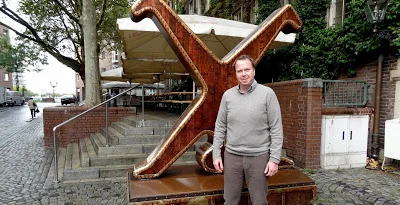
Two unrelated quotes today from Michael Schnitzler, the Weihenstephan-trained owner of Hausbrauerei Uerige. To go with them, I'll show you two photos, one of Michael, and one of the brewery. It contains, as you will see, one of the more unusual anachronisms still in use in Germany.
Read More
In Defense of Clarity
What humans prize is inversely proportional to what is common. Is this a need to desire what others don't have? Do we have a gene that tells us the rare is useful to survival? Whatever the reason, it's an iron law, and one we follow, in the manner of self-parody, back and forth across the decades.
Read More