Vignette 23: Perkins and Tod (Allagash)
“I was adamantly against it. When I went over to Belgium with a few other brewers two years ago, I was like, we gotta do this, we gotta brew these beers. [But] when I got back I thought: it’s too much work, it’s too risky, it’s too risky having all those microbes in the brewery.”
Read More
Budweiser's Weird New Amber Lager
In one sense, this isn't entirely surprising. Going to the archives has become a time-honored tradition, particularly in recent history. In an effort to move toward full-flavored beers without acknowledging craft beer, many venerable companies--Guinness, Carlsberg, Coors--have come out with their own throwbacks.
Read More
Reverend Nat and the Future of Cider
Local, artisanal ciders are doing very well. There's not a clear definition of "craft cider," but by one measure these cideries were up 40% last year. In key regions like the Pacific Northwest, Upper Midwest, and New England, they have taken root and seem to have emerged as a permanent player.
Read More
Behind the "Take Craft Back" Campaign
This follows the summer launch of a effort to enroll member breweries an independent seal program. "Take Craft Back" is the second prong in the larger campaign. It was a surprising, creative, and frankly aggressive move to engage the fight against "big beer."
Read More
Better Names, Please
I get it; names are hard. There are 5,000+ breweries in the US alone. Add to that the trademarked beer names and you're getting up there. A lot of the good and obvious ones have either been taken. But come on, breweries of America, we can do better.
Read More
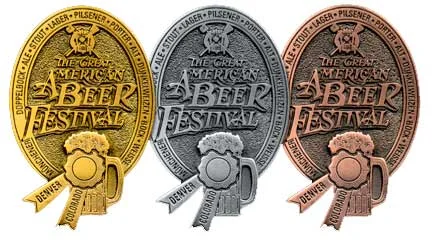
GABF By the Numbers
We all know that California won more medals than any other state at the Great American Beer Festival. Pssh. Of course it did!--it's got a million breweries. To really find out how well a state did, you have to know how many entries they had. I've got you covered.
Read More
What Do Breweries Get Out of the GABF?
It's expensive to enter, winning is a crapshoot, and anyway, there are so many medals that a win is likely to get lost in the shuffle. Most consumers don't track these things, and if they learn a brewery has won an award, probably don't care. All of which raises an interesting question. Why bother?
Read More
Vignette 22, Olivier DeDeycker (Brasserie Dupont)
"So we speak of a beer with a low alcohol content, high bitterness, no residual sugar, so a refreshing beer. It was what we call in Belgium biere de saison, saison beer, brewed in the winter and drunk in the summer."
Read More
I'd Like to Thank the Academy
The North American Guild of Beer Writers announced their annual awards this morning, and the judges saw fit to acknowledge a few things I wrote last year. It's very special about being honored by your colleagues, so this means a lot.
Read More
Remaking a Flagship
Like every brewery of a certain age, Hopworks once-novel IPA started to taste dated once the newer wave arrived a few years ago. In a surprising, fascinating move, Hopworks has reformulated their flagship, a makeover that changes everything (including the label) except the name.
Read More
"Craft Beer" is Dead
Not that we needed further evidence, but a recent collaboration between a brewery and a national doughnut chain definitively and conclusively confirm that the term "craft beer" is meaningless.
Read More
The Paradoxes of Saison
It is the third most-brewed beer in the US and yet has no significant best-sellers. It is called "rustic" but is prized for its sophistication. It is the broadest style in the world--if you can even call it a style--and yet most of the tradition traces itself pretty directly back to a single beer.
Read More
The American Lambic Wars
In one of the tinier pockets of the brewing world, a heated debate rages. What should Americans call the beer made in the manner of spontaneously-fermented Belgian lambic? This wasn't remotely an issue until about 2007, when Allagash Brewing started a program that followed the practices quite closely. There may have been some efforts along the way toward traditional lambic-style beer, but Allagash built a dedicated coolship room and committed to an ongoing program making the beer. Last year, one of the small club of Americans making these beers decided to name and codify it, and thus began the debate.
Read More
On Platonic Ideals
Platonic ideals--theoretical states of perfection unattainable in the mortal world--are useful because they establish a North Star. In the real world, no beer ever receives achieves this state but, presumably, if one did, we would all recognize it.
Read More
Class and Culture in American Brewing
The recent Facebook post by Atlanta-based Scofflaw got a lot of attention for its ill-advised tone and photo. More interesting was how it surfaced an issue that doesn't get a lot of discussion: the role class and culture play among beer drinkers, brewery workers, and increasingly, among small breweries.
Read More
Vignette #21, Vinnie Cilurzo (Russian River)
As brewers in the United States began developing their own approach to brewing hoppy ales, a few beers became watersheds in advancing the American palate. One of those is certainly Russian River's Pliny the Elder. I spoke with founder and brewer Vinnie Cilurzo about it back in 2012.
Read More
The Evolution of Buy-outs
In 1993, Redhook's Paul Shipman made an interesting decision--he decided to reach out to Anheuser-Busch. That phone call would eventually lead to the first investments by big beer into smaller breweries, as the company bought minority stakes in Redhook and later Widmer.
Read More
Beer Sherpa Recommends: Breakside What Rough Beast
The difference between a ripe piece of fruit and fruit-flavored candy approximates the difference between a good New England IPA and a poor one.
Read More
Trends, Hot Hands, and Patterns
Thirty-two years ago, three psychologists published a paper "On the Misperception of Random Sequences"--also known as the "hot-hand fallacy." They looked at several data sets and concluded that the previous performance of the player had no effect on the likelihood he'd make any given shot.
Read More
When Pubs Briefly Replaced Banks
The banks closed in early May, staying closed through mid-November. Things had actually been grinding down from March, and it would take until early 1971 for them to come fully back on line, so "banking in Ireland was disrupted for nearly a full year."
Read More