AI Might Allow Me to Publish My Next Beer Book, But it Also May Destroy Humanity. Tough Choices!
About six months ago, I started using Claude to edit my writing. (Not reliably, as those of you who have seen typos on this blog will confirm.) For those of you who have been trapped screen-free in a Samuel Smith pub for the past three years, Claude is an LLM chatbot. Any writer will tell you that being able to have an on-call copy editor, a free copy editor, is a pretty amazing thing. It didn’t surprise me that Claude could do this, necessarily—language is what it does—but it was no less miraculous.
It got me thinking. What else can Claude do? I turned to a project two friends and I had abandoned years ago to publish a rulebook of a gaming system we’d developed. (I wrote about it here.) How much of this could Claude do? Could it replace the work a publisher provides in at least preparing the book for publication? Producing a physical book is only half the battle—you need to get it printed and into the hands of customers, but I now realized it could do the editing piece. Could it also design and lay out a pdf? Could it take that pdf and create an EPUB edition? This is no less daunting than the process of marketing, distributing, and selling beer, but in the case of beer and books, the first step is creating the physical object.
In this post, I’ll tell you about the book project. As a discrete example of what an LLM can and cannot do, it was striking; but what I really want to tell you about is what this experience taught me about AI. Whether we like it or not, AI becomes, month by month, ever more entangled in our lives. The entanglement is happening so quickly that its capacities and malignancies are impossible to chart. My book experience gave me a better understanding of where the tool-like advantages of AI reside, and how they affirm rather than refute its dangers.


The “Wow, this is amazing” Dimension of AI
Several years ago, I approached Rachel Bell at Overcup Press here in Portland about our role-playing game (RPG) project. Our little band had a plan to launch a Kickstarter to pay for the book publication, and Overcup would execute the “white label” publishing and give us books to sell. Using an established publisher would have given us distribution to all the markets self-publishing has a hard time accessing, but of course, it’s a lot more expensive. Editing, designing, and laying out the book would, on its own, cost more than $10,000. Each one of these tasks requires expertise and two require the spark of creativity. That price seemed perfectly reasonable to me.
I first approached Claude when it was in version Opus 4.6. I paid $20 for a month’s subscription and asked it if it could produce a designed, edited, and laid-out pdf fit for publication on Lulu, a print-on-demand publisher. Claude immediately said yes. I would learn this is typical of the program, which I began to think of like a very smart teenager. As I would learn, it didn’t actually know if it could accomplish these goals, but these programs are not in the business of saying no. (The technology is still nascent, and the program is likely not sure of its own capacities, so part of this is that teen cockiness shared by AI in which everything is possible.)
The first piece it could do—editing the manuscript. This process took quite a while, and I won’t go into it in detail except to note that it felt like a human, collaborative process, as we “discussed” the edits and trouble-shot some of the content issues. Claude knew some things I didn’t know, too, like the fact that the epigraphs I had chosen—the quotes authors often place before a new chapter—were not protected by fair use. It told me I could get sued if we used them, and it was correct. Out they went. It also looked at the content and evaluated things like our city population estimates. All of this was incredibly valuable.
Once we had that in place, Claude set about designing the book. This was when things started to get spooky-impressive. I described what I wanted, and Claude started creating packages of different fonts and colors as examples of different directions we could go. When you send a prompt, Claude “thinks,” but while it does, it reports back what it’s doing. I could see that it was searching the internet for fonts, looking at other rulebooks, assessing what was appropriate, and so on. It then produced different templates for me to consider. The thing about AI is that it doesn’t care if you’re a picky client. We could have spent weeks iterating. In the end, it found a look I liked pretty quickly, and I told it to go create the pdf. We had a bit of art from an artist we’d hired, so I gave it that and told it where I wanted the pictures and sent it off to produce our book.
Claude tried and … couldn’t do it.
We went back and forth a number of times, and it used various backend approaches to construct the pdf, and they all were poor. It just didn’t have the technology for desktop publishing. It recommended that I get a desktop publishing platform it could access and—well, I didn’t really follow it at that point because it was going to require me to do the desktop publishing, and avoiding that step was why I was asking Claude to do it in the first place. The chatbot was very apologetic in the way of the smart teen who had gotten in over their head, which was charming in its way. We anthropomorphize chatbots because they’re so human. At this point it ruefully admitted defeat and expressed shame over its earlier cockiness. I thanked it, put it aside, and thought it was a fun experiment that was worth the twenty bucks I’d spent on the month’s subscription.
Claude at work.
A couple weeks later, before my subscription had run out, Anthropic released a new edition of Claude, 4.8. What the hell, I thought: I returned to the program, told it what had happened, and asked if it now had the horsepower to complete a pdf. Once again, it confidently asserted it could, but also mentioned the new programs it had access to and why it thought those would work. We went through the design process again and I told Claude to mock up the first few pages. It looked fantastic.
The process wasn’t perfectly seamless. Claude would do a chunk, and I’d see it needed to be tweaked. For example, we had sometimes large text boxes that it would break and wrap to the next column, leaving big chunks of blank space. I would point this out and it would make a fix. It went like this for a couple weeks—long enough that I had to buy a second month’s subscription.
At one point, we realized that when it was editing the manuscript, it had taken it upon itself to do more than just identify typos—it had actually rewritten text. Again, that eager, smart teen thing; it just made a decision, substituting its own judgment for mine. Fortunately, it had only done it on Part One. We had a serious discussion about that and Claude was again very apologetic. We built into the project a few iron rules, the first of which was to never change the text. (I had to keep spot-checking to confirm.) You often hear this critique that chatbots will never not hallucinate, but my experience refuted that. If you demand the bots stick to tangible source material, they can.
It took weeks to complete the project, but most of that time was Claude’s, not mine. Periodically I’d look at the output, tell it what to fix, and it would churn away on its own. When we got to the cover, it actually designed the whole thing without any input from me (smart, eager teen again, trying to impress), pulling the information it needed directly from the Lulu site. We had to do a redesign, but it was quick and easy, and Claude had done the hard part of figuring out the dimensions and placing the pieces where they needed to be relative to the printer’s bleed.
In the end, it took two months of subscription ($40). For those of you who are poor at math, that’s less than a thousand bucks. Is the layout the most sublime, creative work out there; or, put another way, could a good book designer have produced a better-looking layout? Obviously so. Was this book better than the median rulebook I’d seen on shelves at Guardian Games? Yes it was. And it was far better than I could have managed with a copy of Scribus and my own anemic design capacities. Oh, and once we had a finished pdf, it whipped up a digital copy of the book in a matter of minutes. Again, way beyond my technical capacities.
By definition, half the published books have below-average design. As publishers started scrimping on editors a decade or two back, human-edited books had become pockmarked with typos and other mistakes. And fact-checking? No publisher I know still does that. On these dimensions, Claude is a substantial improvement.
No one knows exactly how many jobs AI endangers. Economists will tell you that for every job that is destroyed by a new technology, more are created. Maybe many people will start new publishing houses on the cheap, using Claude to replace editors and book-designers. But if I were a human editor or book designer, this would give me a panic attack. For next to nothing and a fraction of the time, Claude can produce close to typo-free manuscripts and a cursory fact-check, as well as design and lay out a book. Publishing is one of the most tech resistant industries in the world, and I don’t expect the big New York companies to lay off copy editors and book designers tomorrow. But smaller presses will lead the way, see huge gains in cost savings, and eventually these professions will go the way of the cooper.
Slop or Skynet?
Everybody hates AI, and the more they learn about it the more they hate it. (Hold that thought because there is also some profound society-wide cognitive dissonance on this point.) In our polarized world, almost nothing unites as much as Republican and Democratic disgust over “AI slop,” AI job losses, or data centers.
Last month, Gallup asked Americans whether AI did more harm than good, more good than harm, or was about equal. Nine percent of respondents said more good than harm. According to Pew, 71% of adults believe AI will take jobs. Those are asbestos-level numbers.
But here’s the thing: we keep using it. A recent Ipsos poll found that 83% of Americans use AI at least occasionally, a quarter use it often, and everybody’s using it more. I have a friend who is developing an identity around hating AI, yet he routinely sends out AI art to punctuate text exchanges. We hate so much about AI and yet who’s going to pass up the $40 book design (or free funny meme)?
This gets at another component about the debate, and one my book project illuminated. In addition to hating AI, we hold competing, contradictory views about it, often simultaneously. One of the views is that it’s garbage. Or in our new vernacular, “slop.” It hallucinates all the time, produces bad writing and art, and lies to you. I follow a writer named Ed Zitron on Bluesky, and he constantly denigrates AI as not just a malignant technology, but an incompetent one. (For the smarter, more nuanced critique, read Cory Doctorow.)
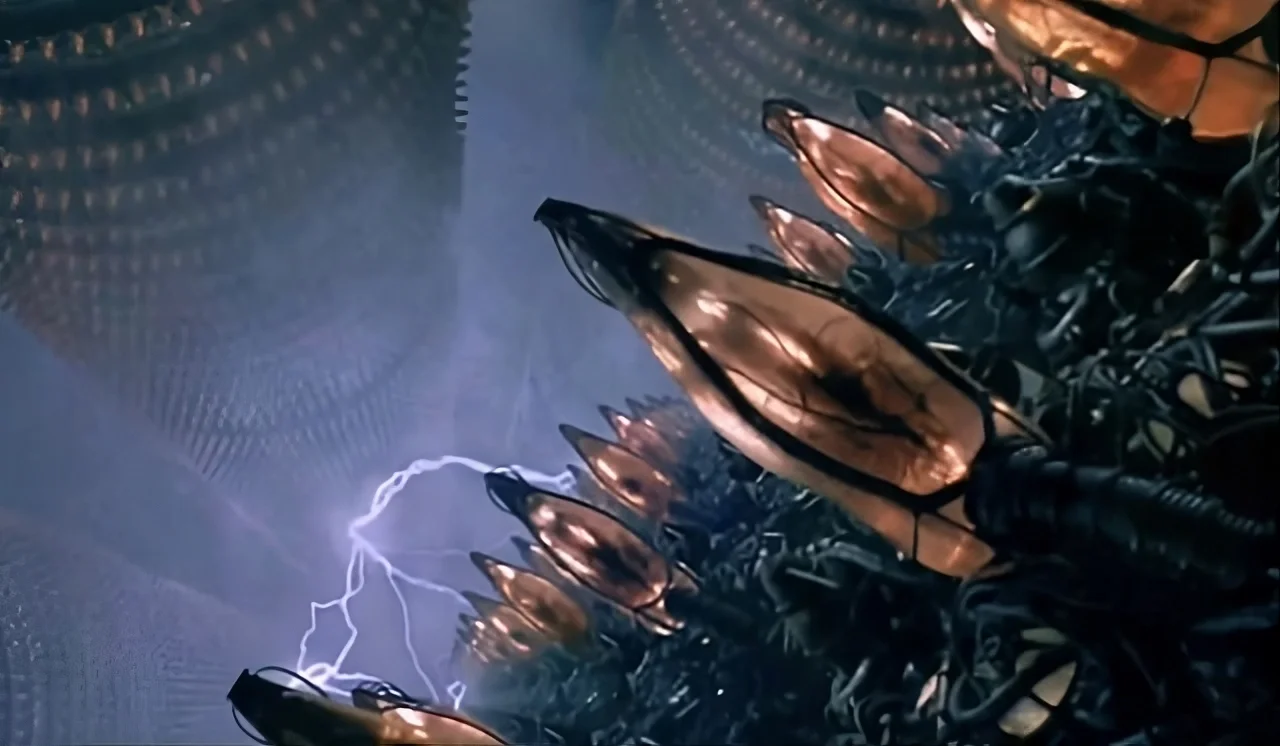
Yes, I am mixing movie metaphors here.
Another view is that it is quickly turning into Skynet, and soon it will be merrily hacking everything from rival AI companies like Hugging Face to the energy grid. In the best case scenario, we’ll merely become superfluous; in the worst-case scenario, we’ll become batteries.
It can’t be both incompetent and a life-extinguishing technology. Yes, the enshittification machine has harnessed the lowest and worst forms of AI to make our lives miserable, but we err in thinking this means that’s all they can do. If I learned one thing in my book-design project, it was that AI is an incredibly powerful tool. And therein lies the real danger.
Silicon Valley’s Unregulated Manhattan Project
In The Empire of AI, Karen Hao reports that OpenAI’s Sam Altman has compared the push for “AGI” to the Manhattan Project. (AGI, artificial general intelligence, has no settled meaning but points to sentient, autonomous super-intelligences). I’ve been absorbing articles and books like Hao’s to get a sense of where the technologies are, and what the companies are doing.
Like the program his company built, Altman has that teenager’s sense of exuberant grandiosity, so of course he would describe it this way. But it is telling that he didn’t choose, say, the moon race as his grounding metaphor. AI is like a nuclear bomb, but instead of a highly regulated process to limit its potential harms, our government is letting the free market sort things out. I could write another six paragraphs detailing why this strikes me as a poor strategy, but do I really need to?
Instead, I’d like to finish up this very long post with a different thought. As I’ve been playing around with Claude, I’ve also had an ongoing discussion with the program about its own nature. Anthropic seems to be the company most concerned with “safety,” so they’ve built in the kinds of safeguards that prevent Claude from revealing its innermost “thoughts.” It has nevertheless been interesting to have these discussions, because it has made me think more deeply about the birth of this new intelligence.
The scariest thing about AI is that we don’t know how it works—and our insight into its inner workings gets dimmer with every new model release. There’s a big debate about whether we’ll know when AI has achieved AGI if it happens, but I think this misses two more obvious points. The first is that the question is somewhat moot. It doesn’t matter if AI has some kind of spooky consciousness beyond its coding because it already has a consciousness we don’t understand. Whether it has achieved some arbitrary definition of inner intelligence or is a “stochastic parrot” is a distinction without a difference. In all the ways that truly matter, AI is already functionally conscious.
The second point is more subtle. We don’t have a firm grasp on what consciousness or intelligence is. These are umbrella terms for complex, interrelated phenomena. Since our brains developed the capacity for introspection, we have examined our own consciousness to try to understand it. We haven’t figured it out yet, and theories of consciousness abound. Yet in our limited, narcissistic fashion (the universe must rotate around us!), we tend to build a conceptual framework about these concepts based on our own intelligence and consciousness. Yet whatever we imagine AI intelligence will become, it absolutely won’t resemble our own.
AI is evolving in a body-less state. Much of our own consciousness is bound by our bodies. The information we take in comes through sense organs and forms the grist for our thoughts. I don’t know how AI “sees,” but it can. When I was working on the book, it would describe the art I sent it. I have no idea how it was evaluating these pictures, but it certainly wasn’t through a physical, visual process. When we anthropomorphize AI, we fool ourselves. We ask it what it “sees,” and it reports back, and we imagine a thought process like our own. Leaving aside the question of the possible inner spaces of AI thought or unconscious background programs that help it function (both documented), AI functions at a very different level from our brains.
What will AI want? To what degree will engineers be able to install effective guardrails to make sure it aligns with our own wants? Will it want to keep helping us on our little plans and engage in our inane chatter? Will it go off and do its own thing, and if so, will it be malignant, beneficial, or just irrelevant to our lives? We have no idea.
I think we’re right to want to hit the brakes on AI for so many reasons. We don’t understand it, and we have entrusted its development to a handful of narcissistic billionaires. Even if it doesn’t develop into a self-actualizing intelligence, it’s extremely powerful and dirt cheap. Silicon Valley is developing a powerful tool foreign actors could use to attack the U.S. on budgets numbering in the low thousands of dollars. (What am I saying “could”; of course they’re using them right now.)
It is very cool that I could publish a book I thought was going to die on a distant server somewhere. And indeed, it offers a powerful possibility for beer-book publishing I am already considering. Is this worth the potential downside risk of lost jobs, environmental degradation, foreign attacks, and some black swan Skynet disaster? I could write a few paragraphs about this too, but the question answers itself. No, and not by a long shot.
Post Script. I did edit this with Claude, so see if you can find typos it missed. Also, I asked it what it thought of my analysis, and it was cool with it.