Another Landmark IPA Debuted 30 Years Ago
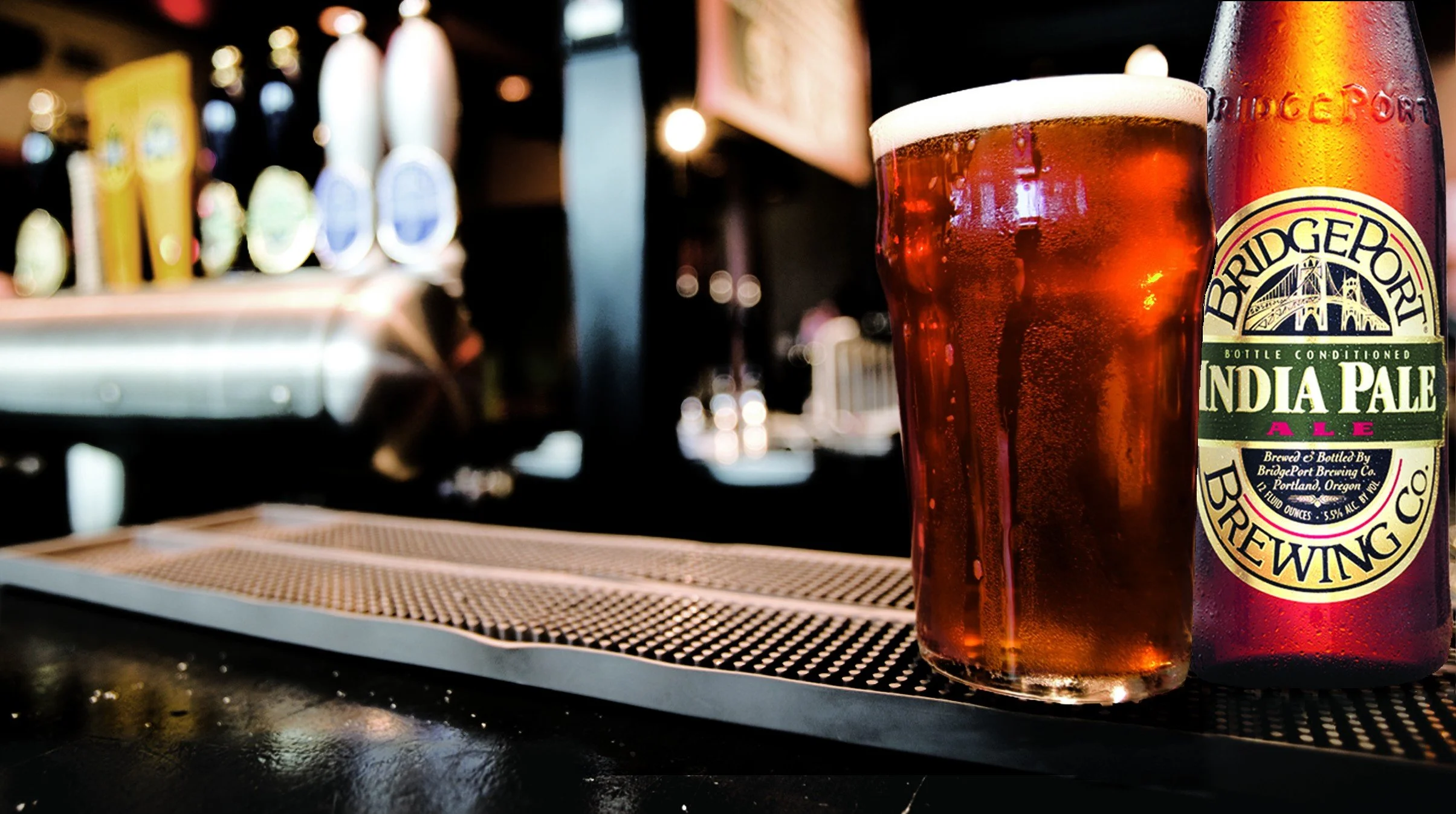
Original PR shot from BridgePort
Thirty years ago, roughly around this time of year, I met a college friend at the now-defunct Gypsy. It was a dive bar across from Cinema 21, where we would later go to watch a movie. She had left Portland for LA to pursue a career in film, and I was a bit adrift, having washed out of graduate school to end up driving a cab back in Portland. It was a lifetime ago—for some readers, literally—and the incident has taken on that dreamy quality of old memory.
I would have forgotten the entire encounter except for one thing. I happened to order a new beer that was picking up some local buzz, BridgePort IPA. I hadn’t started writing about beer, and was very much just a young civilian drinker. It didn’t take advanced training to spot a winner, though: I knew immediately that I was encountering something special. It was so vibrant. In 1996, the word “IPA” indicated a caramelly tincture of bitterness. These beers did have tinges of citrus at the margins, but working with old first- and second-gen American hops and tried and true brewing methods, they were mainly sharp and eye-watering.
The podcast we released this week on Pliny the Elder got me thinking about BridgePort’s contribution to American brewing. It was the first IPA you could reasonably describe as “juicy.” By 2019, when BridgePort shut down, people would have called it old-fashioned, perhaps not realizing how far ahead of its time it was 23 years earlier. Now that the defunct brewery is fading from memory and BridgePort IPA never made it far outside the Pacific Northwest, people may not realize its impact. On this 30th anniversary of its release, let’s remember why BridgePort IPA was so important.

Karl Ockert was the founding brewer at BridgePort, and a local legend, but he had left on a rumspringa with Anheuser-Busch for a few years. In the interim, Australian Phil Sexton had joined BridgePort. He had seen the Oregon hop fields and was taken with the quality of then-new American cultivars. In 2014, Sexton returned to Oregon and described why he was pushing for a hop-forward beer to showcase what he discovered in the fields.
“[Brewing at the time] was heavily weighted toward Fuggles, Goldings, and a lot of imported hops coming in. I trained in England, and I thought, ‘What are we doing here? These are the best hop fields, probably in the world.’ It was like Christmas for me. Particularly the ones that impressed me the most at that time were the ones that had that incredible citrus character that you get out of Cascades. These were the most beautiful hops I’d ever seen in my career, in the world—so why aren’t we using them? So that’s really how we started working up with this IPA, was just increasing and turning up the dial with the amazing character coming from the Cascades. And also the Chinook and those other varieties that just had this incredible aroma that gave the beer the passionfruit-y, citrusy character.”
For years I was slightly put out that a foreigner was the one who pioneered this beer, but when you hear him talk about the hops he found in the US, it makes sense. A foreign eye is sometimes able to spot the exceptional where a local eye sees the ordinary.
Karl Ockert returned to BridgePort in March 1996, when the beer was already in development. He helped refine the IPA, paring down the complex grist and hop bill. The big innovation was including a “massive” hop addition to the hop jack—though by modern standards, of course, it would be considered modest. It infused the beer with levels of flavor and aroma that most people had never tasted before. I certainly hadn’t.
Thirty Years Ago
IPAs had been a fixture in Oregon for a decade by then (going all the way back to 1983 in the Pac NW), so a new IPA was hardly noteworthy. A lot of Oregon breweries offered them, so BridgePort wasn’t breaking new ground with the style. Since its inception, BridgePort had focused on traditional British styles as well as cask-conditioning, though, so for the brewery it marked a surprising turn.
To situate you in time, 1996 was the year Stone Brewing was founded, a year before Arrogant Bastard came out. Bill Clinton was running for his second term. The Widmer Brothers had just taken an investment from Anheuser-Busch (AB InBev was 12 years away) and released their runaway hit Hefeweizen in the bottle for the first time.
Craft beer hadn’t yet hit its first down-cycle, which would arrive in a couple years, and breweries were busy putting out a ton of weird and often bad beer. This is what really marked the 1990s: it was far from obvious that hops were the future of craft beer, and in fact, fruit flavorings were the buzziest part of the industry. In this way it resembled the milkshake IPAs and smoothie sours that would emerge right before the second dip two decades later.
Meanwhile, most of the hops that define modern brewing were years or decades away. Breeders at the USDA had been focused on producing European-style hops, and they did release some awesome varieties (that are now sadly overlooked). If you wanted to make an IPA with American-style hops, you basically had the c-hops to work with: Cascade (1972), Chinook (1985), Centennial (1990), and Columbus (1992). Simcoe, Amarillo, Citra, Mosaic—in ‘96, these were all still in trials if they had been bred at all.
BridgePort IPA Arrives
To go back to my first encounter with it at the Gypsy, I remember thinking that BridgePort IPA tasted like the future. It seemed so obvious that this was how beers should present themselves: the aromatics billowed off the glass, and the flavors were bright and intense. The beer was listed at 50 bitterness units, but they were subdued—or perhaps occluded—by all the flavors and aromas. I am famously bad at predictions, but I distinctly recall telling my friend, “BridgePort is going to sell a lot of this beer.”
They did. Although some breweries made IPAs in the years before BridgePort’s, none of them had yet turned the style into a flagship. By memory, I don’t think anyone would again for some time. I recently contacted Karl to ask him about how it transformed the brewery.
“As I recall, although there were others making more of a niche British interpretation of an IPA, ours was specifically using domestic hops and we focused all our sales efforts on breaking new ground. The aroma and flavor of our IPA was such a new thing that we won gold medals at the GABF in 1996 and 1997 and the very prestigious Brewing Industry International Awards in London in 2000. The beer’s success turned our production schedule from making mostly Blue Heron and Coho Pacific into about 75% IPA in a short time period (don’t remember the specifics). It rapidly turned into our flagship.”
Because BridgePort had this DNA of a British-style brewery, they were using an English yeast strain. This was also unusual at a time when so many breweries were using Sierra Nevada’s much more restrained Chico strain. Phil Sexton was very focused on goosing the esters to complement the fruit character in the hops. This was another innovation that didn’t really influence Oregon brewers—but did precede hazy IPA’s focus on esters as a way of maximizing the “juice.”
Karl Ockert in 2017 (I think)
Phil Sexton in 2014
It was a malty beer, but not as caramelly as many beers of the time. Karl Ockert: “The beer’s malt bill was a blend of about 90% Great Western Northwest Pale Ale malt (which I helped develop) and equal parts of crystal 40, malted wheat, carapils and flaked wheat.” And the hops?
“We used no high alpha hops or extract in the kettle but instead a blend of Oregon Cascade, Oregon Golding, Washington Ultra, and Oregon Crystal hops at 3 stages in a 90 minute boil for both bitterness and flavor. But the real secret was our use on the hot side of a hop jack (hop strainer tank) where we piled in 75 lbs of whole leaf Cascade, Chinook, Crystals and Ultra. The flavor impact of this addition as the hot wort ran through was incredible, tasting pre- and post-hop jack worts were like two different beers.”
Crystal and Ultra were sister hops bred by Al Haunold and released in the early 90s. Daughters of Hallertauer Mittelfrüh, both were intended to be noble-style cultivars. Crystal isn’t usually included among the c-hops, but it does have a wonderfully bright citrus character. I don’t believe Ultra is even grown any more. I have many criticisms of Carlos Alvarez, the Texan owner who bought BridgePort in 1995, but he did support the creation of this landmark IPA, and he also encouraged the brewers not to filter the beer. Although the pictures I was able to find for this piece show a bright beer, it was rarely that brilliant. More often it had a notable haze—a characteristic that would become so common among Oregon IPAs that I was confused by the emergence of the hazy IPA phenomenon when it arrived—I thought all IPAs were hazy.
Legacy
In writing my Making of a Classic series and recording the One Iconic Beer podcast, I’ve spent a lot of time trying to identify causality in beer styles. It is never linear, and the more closely you study the way beers emerge, the more you see how many influences went into a beer. Had BridgePort never existed, Americans would have figured out how to draw the flavors and aromas from their intense native hops. BridgePort IPA did exist, however. “Other brewers were very curious,” Karl said. “I heard from and discussed certain production and ingredient aspects with brewers from all around the US and the UK.” Bit by bit, brewers were experimenting with American hops, and when something like BridgePort’s hop jack experiment worked, it filtered throughout the brewing world.
Oregon was and remains a very collaborative environment. Brewers told each other what they were doing. I remember Ben Edmunds describing a new practice for kettle-souring they’d discovered at Breakside. After he told me about it, he asked if I could hold off reporting about it so they could have a month or so before everyone learned what they were doing. There’s also the sensory impact of beers that arrive ahead of their time. BridgePort was an outlier, and many people had the kinds of experiences I’d had. In 2000, when Karl was in Britain, a retired brewer from Greene King had this same “Aha!” moment. Karl described it:
“We had brought over a few cases to share and he took a whiff. He exclaimed he could not pin down the aroma profile and when I informed him they were coming from American hops he remarked ‘No, American hops smell like cat piss.’ That was the American hop reputation at the time.”
On One Iconic Beer, I give one of our guests the final word on the legacy of a beer, and it seems appropriate to do that with Karl now. Thirty years ago, he and the team at BridgePort made an important beer, one worth remembering.
“Although closed now, the BridgePort IPA recipe lives on in the Australian brewed Little Creatures Pale Ale (which Phil founded when he returned to Australia) and the Cornish brewed St Austell Proper Job IPA made by my good friend Roger Ryman. I know that we weren’t the first to make a hop forward IPA, but I think we were at least among the first to focus our hop forwardness on American (Northwest) hops. I believe that the IPA style literally saved the American hop business, especially after the disastrous Inbev takeover of AB. And I like to think that BridgePort’s IPA played an important role. I am very proud of this beer.”