The Kinds of Beers Americans Drink Now
The annual Oregon Beer Award judging concluded on Sunday afternoon, and the winners will be announced on Thursday (at a grand ceremony you can still buy tickets to attend). I judged this year, and as the organizers encourage, I carefully studied the style guidelines. When I was about halfway through the newly-collapsed catch-all category combining two previously separated catch-all categories (Classic UK and North American styles), I had an epiphany. Because of the way the OBA organizes styles, the guidelines become an excellent heat map for where Oregon beer is at any given time.
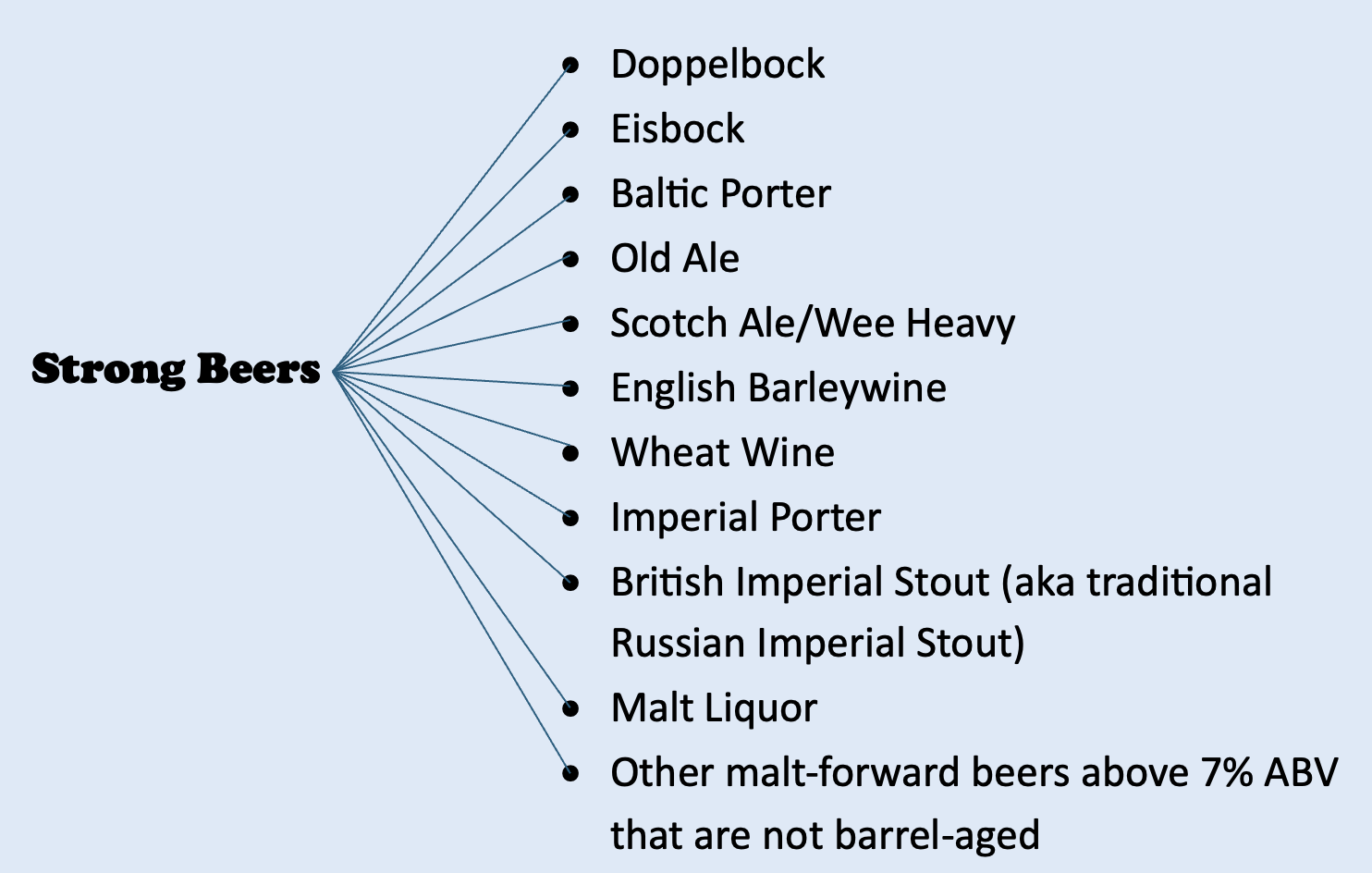
The strong beer category and the styles contained within.
The Oregon awards, which have sparked similar versions in Texas, Ohio, Montana, New York, Alaska, and Colorado, do not follow the GABF and World Beer Cup guidelines, in which every style—now numbering around a hundred—gets judged alone. Instead, the Oregon organizers try to create categories that have somewhat similar numbers of entrants. Since not many people are going to enter an altbier or Belgian dubbel, they collect these into larger collections of similar styles.
This isn’t a judgment rendered by the OBAs of a style’s innate worth—it’s based on how many beers of various kinds get entered. So, for example, in 2018, classic North American styles was one of the largest categories. But no more. The number of beers in that “classic U.S. and UK” category (bitters and browns and ambers and wheats) continues to dwindle. Classic UK styles were not as popular 6-8 years ago as North American styles, but they, too, have bottomed out. Now it’s a category containing eleven distinct styles.


Other styles are becoming more dominant. American IPA and hazy IPA have been so popular that they each draw large numbers of entries on their own. In fact, last year the OBAs split American IPAs into two, creating a new West Coast IPA category. Again, the OBAs didn’t make a choice from on high that WC IPAs are so hallowed as to deserve their own category. West Coast IPAs have emerged as a distinct style, sure, but there are also so many of them. This mirrors what’s happening in the industry. Most breweries now have some kind of non-specific American IPA, a hazy, and a West Coast. I’ll include the list of styles from the guidelines below so you can see how it shakes out. Note that there are six categories for hoppy ales (and they exclude fresh-hop ales, which is certainly a marker of Oregon-ness you’re not going to see many places).
Style popularity over time.
I’d also bookmark lagers here. Pilsner is now one of the most popular styles in the Northwest. You see that on taplists, and you see it in the OBAs, where it has its own category. As lagers become more popular, they get more categories at the OBAs.
- Pilsner (2 styles, in this case German and Czech pilsners)
- Golden, Blonde, and Other Light Ales (4)
- Hoppy Lagers (~4)
- Light German European lagers (~9)
- Dark German and European Lagers (~4)
- International Lagers (~6)
- Stout/Porter (~6)
- Classic UK and American Styles (~11)
- Belgian Beers, German Wheat Beers, and Traditional Brett Beers (~17)
- Red Beers (5)
- Strong Beers (~10)
- Sessionable Hoppy Ales (~5)
- American IPA (1)
- West Coast IPA (1)
- Hazy IPA (1)
- Imperial IPA (~4)
- Dark Hoppy Ales (~7)
- Barrel Aged Stouts (~1)
- Those categories rounding up beers that don’t fall into broadly-defined style categories: Flavored Beers, Fruit Beers, Coffee and Smoke, Experimental and Historical, American Sour, Mixed Culture, and three categories of fresh-hop beers.
Discerning Regionality
I have long been curious to see how regions of the country differ. It’s hard to tell purely by observation. Are there more lagers here? Do I detect a strain of fruited kettle sours I don’t see elsewhere? Every time I think I’m onto a trend, I visit another brewery or pub and it seems to vanish. The question arises: would state competitions give us a more concrete measure of locally popular styles? Well yes, yes they would.
Looking at the Texas guidelines, I see a lot of similar categories, except with lagers. They have many more categories than Oregon does: German pilsners get their own style (no Czech), along with American and international pilsners (there’s Czech pils), US and international lager, US and international light lager, session and standard lagers, and strong lagers.
But that doesn’t even begin to prepare you for what’s going on in Montana. Some of the styles make sense and overlap with other states, of course. But behold these categories (I’m taking this from the winners list last year): Scottish-style ales, wheat ales, amber ales and hybrid styles. Scottish ales are such a weird, specific Montana thing—and I’m so happy to see them still rocking. Montana is also clearly not into hops the way we are further west. They have a hazy pale ale category, IPA, and pale ales. That’s it.
Ohio largely adopted the Oregon categories wholesale, but they do include one rather notable addition: spiced holiday beers. Of the 10,000+ beers made annually in Oregon, I would guess well fewer than fifty are spiced holiday beers. The New York awards feature one very appropriate local style: cream ale. New York has historically been the homeland of the style (Genny Cream is the category giant). They also have a brown ale category, God bless them. Did breweries make more than 100 brown ales in Oregon last year? I would be shocked. Finally, Colorado deviates exactly where Oregon is getting weaker—on traditional styles. They feature: malty North American beers, classic UK amber and brown ales, rye and wheat beers, and stouts and porters as separate categories.
Rethinking the Style
I will exit with a final thought about how these competitions conceive of style—or anyway, how they arrange them. In Oregon, they lump styles together that have similar flavor profiles, no matter where they come from. Two in particular jump out. “Red beers” are mid-strength, normal-fermentation beers with an amber to light-brown hue like altbier, Irish red, and American amber ales. More convoluted is “Belgian Beers, German Wheat Beers, and Traditional Brett Beers,” which initially seems very random until you think of the way the yeasts function in these beers. They are all characterized by phenolic (POF+) yeasts, high esters, and even a certain amount of non-acid wild yeast. So you’d put a Bavarian dunkelweizen here, and also an Orval-style Brett-aged Belgian pale, and also a witbier. In both cases, you’re judging beers from very different traditions, but gastronomically they fall in a certain category that does make sense at the table.*
This makes sense from a judging perspective, but it also makes sense from a drinking perspective. If you walk into a pub and you’re in a mood, you’re going to be looking at a category of beers. You may want something hoppy or strong or sessionable and malty. If you want a strong beer, you’re going to be looking for something like a doppelbock or Baltic porter or barley wine, beers from three separate traditions that will scratch the same itch. If you scan through the categories other states have adopted, they fit this conceptual framework as well, even if they organize it differently. One of the reasons I like these competitions is because they reflect the real-world way we drink, and they are also flexible enough to handle the way beers evolve. You may add beers to a particular category as new styles are born, or move them around into bigger categories as they decline in popularity, but you don’t have to dump the category.
I was fortunate enough to be able to judge the finals of three categories, including pilsner, and I’m very excited to see who won. I will report back at the end of the week.
__________________
* In judging these beers, you do take style into account, along with the brewery’s submitted notes on the beer. If you have a beer that just lists a style, you judge it both as an example of that style and how well it competes against the other beers at the table. If the brewery has added a note, you include that in your calculation. A beer might be dinged for being a poor example of its style but elevated for being just an awesome beer or vice versa. If the brewery says it has hibiscus or rye malt or is “American-style,” we would expect it to taste like rye, hibiscus, or elevated hops. You take all of that into account.