American Beer Getting Ever More American
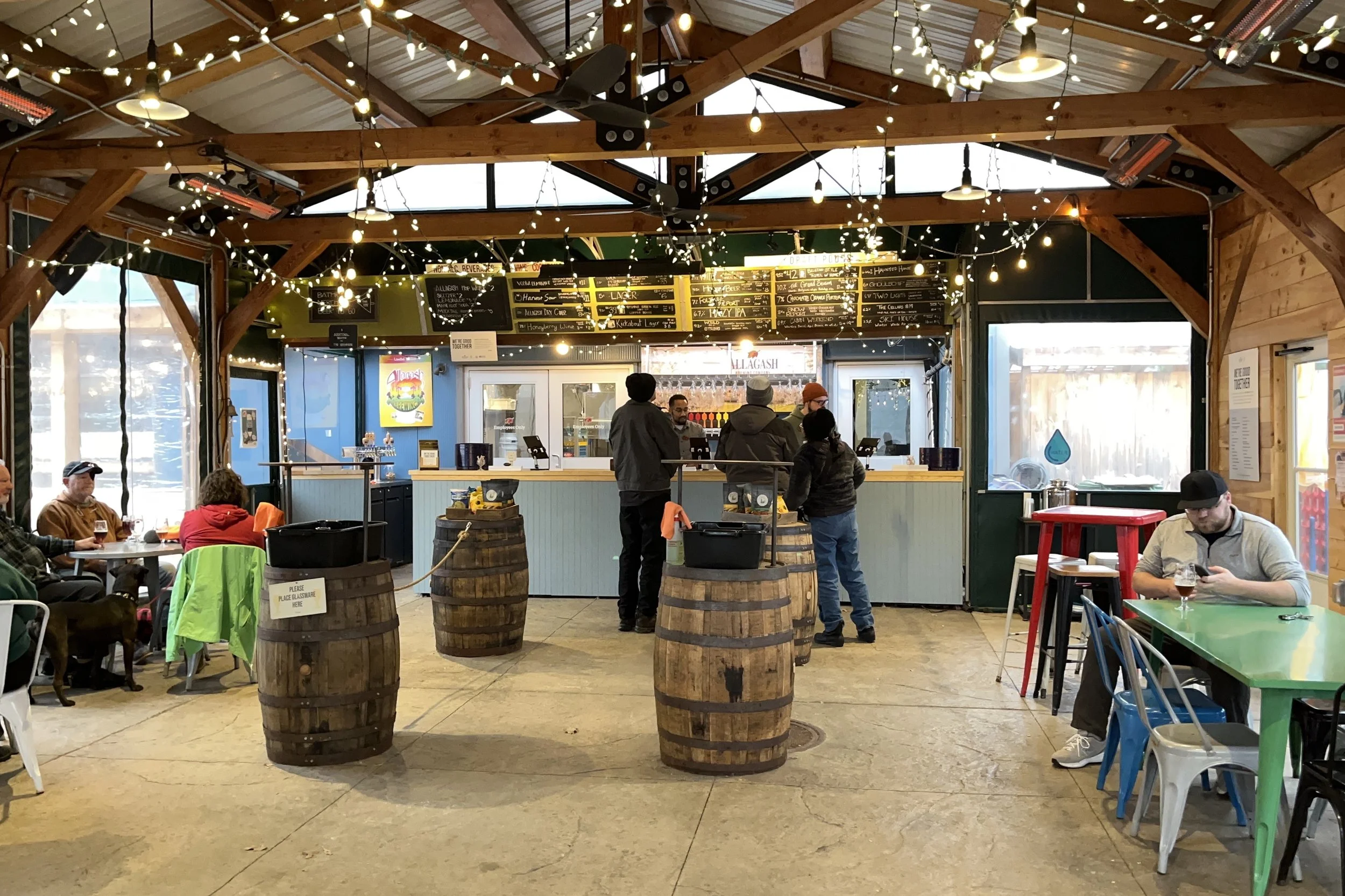
Allagash’s cozy taproom.
The beer scene in Maine is so robust that it has been a few years since I stopped in to check on Allagash, one of the country’s finest breweries. There’s always something new and shiny to see in Portland! I rectified matters this past Thanksgiving, and for my troubles was rewarded with a most fascinating artifact of American brewing.
The beer in question is called House, and when I asked about it, the bartender called it “A Belgian table beer, like a singel.” For starters, the description charmed and amused me: Belgian-style beers have been out of favor for a good decade, so the likelihood that the average drinker understood any of that description approached zero. But I love highly specific, abstruse beer references, so count me in!
I asked for a sample, however, and lo, what I held under my nose smelled very little like anything a Belgian monk might recognize. Familiar scents of the Pacific Norhtwest’s hop fields rose into my nostrils—gentle, for sure, but unmistakeable. I took a sip and my tongue told me the same story. This beer may have been inspired by Chimay or Westmalle, but by the time it came out of the conditioning tank, House was indeed rooted right here in America.


“Yes, there is a decent dose of Cascade in the whirlpool, in addition to Saaz ” Allagash’s Jason Perkins wrote back. No dry-hopping he said, but: “There is also a mid-kettle addition of Mosaic. It used to be Galaxy, but we swapped it with Mosaic a few years ago. While it is a kettle addition, that hop has nice ability to keep its character through the boil.”
I love finding these examples of Americanization. It’s been almost a decade and a half since I toured the great breweries of Europe for the Beer Bible, and what struck me was how strong and specific the brewing philosophy was country to country. I understood that in each country the family of local styles had a certain coherence, but I didn’t get how profoundly this was dictated by preferences in the brewing process.
At that time, Americans were, for the most part, still heavily influenced by European styles. The best brewers understood the processes that led to these styles and replicated them. To a German, the Belgian fascination with yeast and refermentation makes no sense. The Brits can only scratch their heads at the convoluted Czech double decoction. Back at home, though, Americans hadn’t yet developed their own idiosyncrasies.
Fifteen years later, we have. Mostly it revolves around hops, both the varieties grown locally and the way we use them. Americans now use the techniques of whirlpool and dry-hopping almost reflexively. The way Americans hop their beers produces a deeper, more lovely bouquet, so why wouldn’t you do it? Anyway, that’s how the thinking goes, and it is a sign of the kinds of national tradition I observed in Europe.
These kinds of cultural distortion fields can lead to failed experiments. I have rarely tasted a decent German-brewed IPA. (“Rarely” here is a diplomatic term.) But in Allagash’s House, this little American touch was spectacular. I got stone fruit, white wine, and citrus in the nose, and those elements carried through to the palate (albeit at a quieter volume). I didn’t pick up the spice on the nose, but the Saaz is there on the palate, creating a citrus-spice bridge to the lightly phenolic spice of the brewery’s house Belgian yeast strain. “Those spicy phenolics are key,” Jason agreed. The beer is only 4.5%, but Allagash’s mash schedule pushes malt and body forward. Jason also credits the Briess Victory malt (“one of my favorite malts of all time”) for helping make the beer drink more heartily than its ABV suggests.
“It is certainly a staff fave,” Jason wrote, and I believe it. I’d drink this beer constantly if I worked there.
To go back to the start of this experience, the bartender wasn’t wrong, exactly, about what House was. And I don’t want to get anyone in trouble—I’m certain he had been trained to discuss it this way. (Allagash calls it a “Belgian-style Patersbier,” and says it “is brewed in the tradition of Belgian house beer—lower-ABV brews made for the brewers themselves to enjoy after work.”) And while those elements were there for the drinker who had an intimate understanding of Belgian brewing, they were background notes. Instead, from the first scent, it was a beer that Americans would recognize far more easily than Belgians would. A decade ago, certain beer nerds might criticize Allagash for that, but today I think they’d just smile and drink up. After all, they’re Americans, too.