The Evolution of Fresh Squeezed IPA
About a year ago I sat down at the bar of Matador, a local chain Mexican restaurant. It’s not the coolest place in town, but it’s just around the corner and we can usually find a seat at the bar—that plus twelve-dollar nachos ($7 before 6p) that feed four makes it a pretty regular stop. They have three taps devoted to local beer and they’d just switched one of them, a rare occurrence. “What’s the new beer?” I asked. “Some IPA.” (The bar staff are awesome but indifferent to beer.) I ordered it.
What they brought me was a fairly hazy beer with a luminous gold color and a snowy head. It wafted a gentle scent of lemon-lime. I took a drink and was instantly impressed with its understated charms. It’s pure sunny brightness, a palate infused by that spritzy lemon-lime. It seemed fairly restrained in alcohol, an impression I confirmed finishing up my second glass. It was basically a perfect drinking IPA—fresh and delightful with each sip, but harmonious enough that you could happily drink two or three over dinner. Finally I had to find out: which IPA was this? The bartender went to look and came back a few minutes later with the answer.
“Fresh Squeezed IPA,” she said. It wasn’t the beer I remembered.


If you haven’t had a Fresh Squeezed recently, you should. It is a vastly different beer than the brewery released on draft more than 15 years ago, different than the one they released at scale in 2013 and which sent Deschutes through a massive growth spurt. It’s even different than the pretty big re-design they initiated three years ago. The modern Fresh Squeezed is a stellar beer and I can’t imagine any IPA fan not loving it. Instead of trying to turn it up to 11 or placing it on the bleeding edge of trends, Deschutes created what amounts to an ideal sessionable IPA, with the kind of refinement and approachability that marks the best pilsners or cask bitters. (And yes, I understand that a 50-IBU, 6.4% beer does not qualify as sessionable elsewhere, but it does in the U.S.)
I wanted to learn about what happened with the beer, so I spoke to Deschutes brewer Ben Kehs and got the lowdown.
A Tiny Bit of History
Let’s begin with what Fresh Squeezed used to be. Deschutes first started brewing its precursor as a way of experimenting with a sexy new hop that would come to be called Citra. Long before hazies were the twinkle in any Vermonter’s eye, the brewery realized how sweet and fruity the hop was. As Deschutes’ brewers worked with Citra, they did exactly what other breweries would later do everywhere: shifting their process to accentuate the hop flavor and aromatics while tuning up the malts to enhance the perception of sweetness.
When I first tasted the beer, it had graduated to the 22-ounce bomber (truly, the beer is a little microcosm of modern American brewing). In 2013, I sampled a bottle and used a word in a subsequent post that would soon become ubiquitous in American brewing, “juicy.”
“Deschutes put 60 bitterness units in this beer, but it has a ton of caramelly body (it's closer in color to Newcastle than Pilsner Urquell) that adds a lot of sugars to the mix. Layer those intensely fruity new-variety hops on top and you add a level of juiciness the mind tracks as sweetness. From a sensory perspective, these aren't bitter beers at all--they are actually sweet.”
It seemed like a watershed in brewing, and at the time I called this nascent category “sweet IPA” (a term that did not become ubiquitous). It was one of the biggest buzz beers in the U.S., allowing Deschutes to rapidly expand eastward, even encouraging them to consider opening a brewery in Virginia. Hazies arrived as a national phenomenon a few years later, their brewers having discovered many of the same lessons Deschutes learned making Fresh Squeezed (late-addition hopping + full, sweet bodies + English yeasts = $$$). Hazies would soon take over the mantle of the juicy IPA, but Deschutes got there first.
All well and good, except that things changed. The industry mostly moved away from sweet, underattenuated IPAs and caramel malts. By 2022, Fresh Squeezed had become dated and trends were speeding away from where it sat. Like so many breweries, Deschutes confronted a choice: stick with the iconic IPA that had built the brewery into one of the nation’s largest, or update it for a new generation.
The Fresh Squeezed Modernization Project
In early 2022, Deschutes promoted Peter Skrbek from CFO to CEO. Within weeks of taking the job, he’d made the decision to update Fresh Squeezed to position it to remain a major brand. Deschutes already had lots of experience with old flagships, but whereas Mirror Pond (a pale ale) and Black Butte (a porter) fell out of favor because of their style, Fresh Squeezed was an IPA. Skrbek sent an email to Scott Birdwell, then Deschutes’ Brewmaster, with the green light to tune it up. Ben Kehs, whose current title is Innovation Brewing Manager, still had a copy of the note and read it to me: “The goal is not to create an entirely different beer, but to modernize and have the consumer say, ‘Damn, I forgot how good Fresh Squeezed is.’”
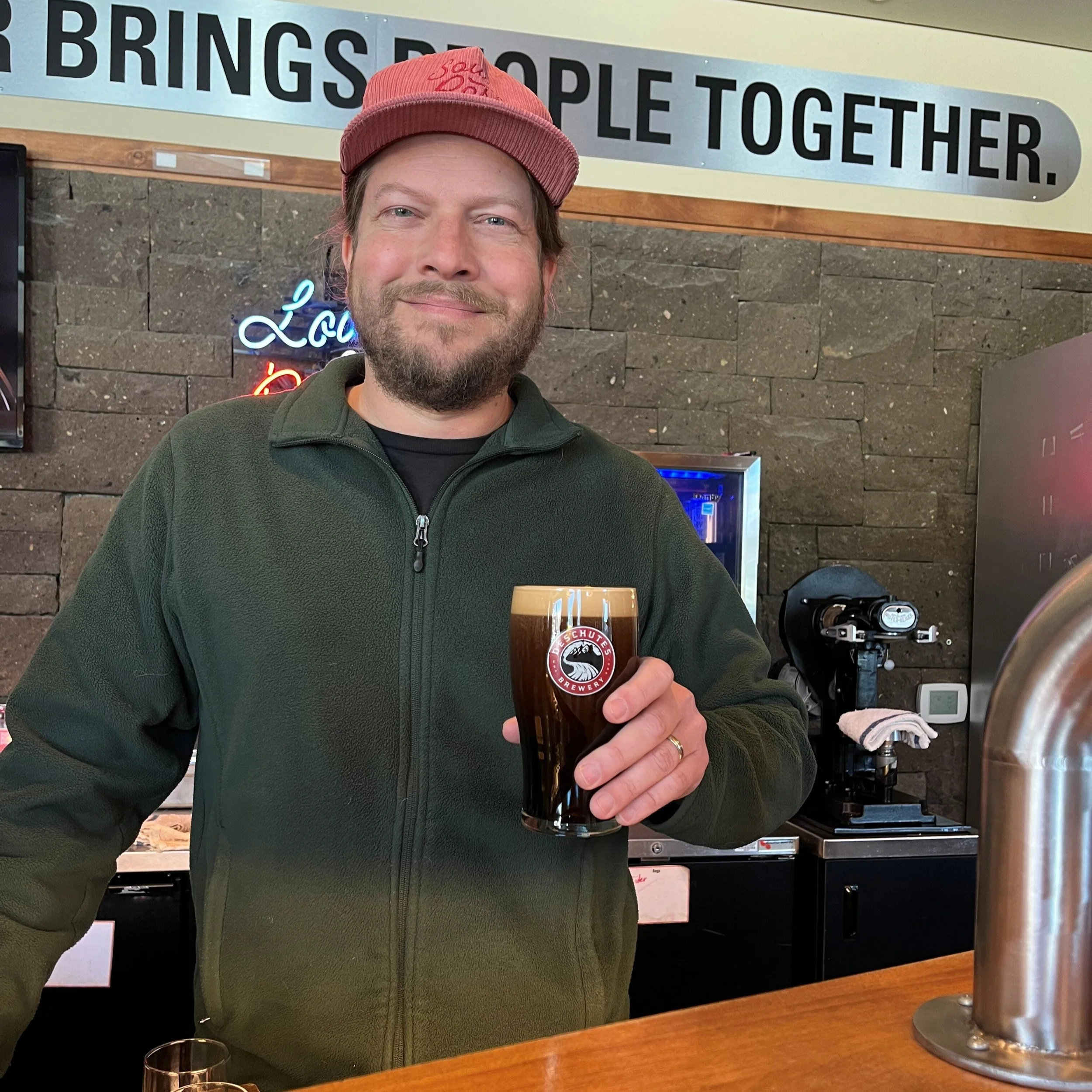
The challenge had a big impact on Ben at the time because, as he put it, “Coming up through UC Davis brewing school, what was hammered into my mind at the time [2004], was that what you might see as improvement, your customers might just see as different. And so, keeping consistency in mind was paramount.” As I wrote last week, the thinking has really shifted on this point. Peter was on the right path, and so the brewery began redesigning the beer, though quietly. (Indeed, earlier this year, I reached out to Deschutes to ask if they’d reformulated the beer because it seemed so different from my memory and Google could direct me to no evidence that they had.)
Deschutes is one of the most deliberative breweries I know, and they set out in a very Deschutes manner by holding an internal competition among six teams of in-house brewers to experiment and try something new. Everything was on the table, and they came back with beers that ranged from just a half-step from where they started to serious overhauls.
“We did all the brews,” Ben said. “We brought in kegs of the finished products and we did a couple different tastings. One was just on-site with all of the Deschutes employees, basically—it was kind of a drop-in tasting opportunity up in our Mountain Room. And then we put together an online survey, did it blind. Every employee was able to come in and taste and talk about what their favorite was.”
From there, they pared down the number of beers to three and presented them to customers, getting more feedback. It’s an iterative process Deschutes often conducts on new beers, and it led them to make some substantial changes over time.
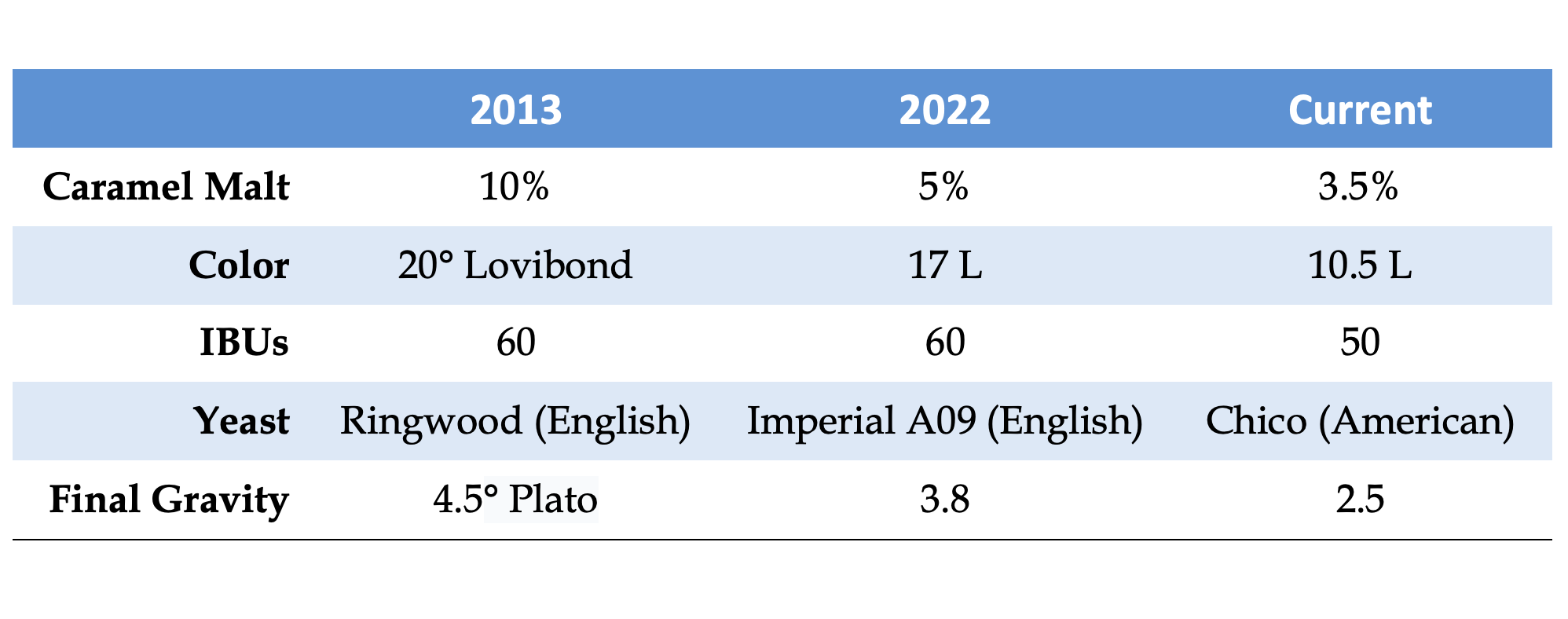
They dropped the finishing gravity to make the beer less sweet and halved the caramel malt, and began lightening the color. The original Fresh Squeezed only used a whirlpool addition with no dry-hopping, so they shifted the process to include a dry-hop addition.
That was just the start. In fact, the first draft of the changes wasn’t a massive departure, but it began a process of evolution that has landed the beer in quite a different place. They released the first draft in package later in 2022, but the beer kept following the trajectory they’d put it on. One of the big changes was the yeast.
“Esters were definitely a big thing,” Ben said. “At the time, we were brewing with our house Ringwood ale yeast. There was a lot of discussion around ‘how is that yeast expression playing with the dry hop, or with the overall hop bill?’ We may not be surprised to find that taking that out, it might showcase the hops a little bit more. And then, a little bit later on down the road, it was probably 2023, or even early 2024, we made a permanent switch to Chico.”
They kept removing caramel malt and lightening the color as well, and now the finishing gravity (a measure of sweetness left in the beer) is almost half what it was in 2013. Ben later sent me the recipes of the first big production batch they did of the beer, what it looked like at redesign, and the current version. Here are the key differences:
Balancing a Decision to Change
As a drinker, the results speak for themselves. I hadn’t had a Fresh Squeezed since before the reformulation in 2022. The beer tasted like a museum piece and was just far too sweet and cakey for my palate. Today I drink the revamped Fresh Squeezed regularly. Every time I do, I’m a little surprised by how sprightly and pleasant it is. But that doesn’t mean it was an easy call to let it evolve.
“You know, it carried a little bit of apprehension with just the uncertainty of, like, where we were going to end up based on how important that brand was and is to our portfolio? What does improvement look like to people? I thought it was a good balance of those two things. We can change up yeasts, we can change up the malt bill, we can change up how we're hopping, what we're hopping with, basically anything, but it has to… it still has to resonate as Fresh Squeezed with the consumer.”
It seems to have worked out. Just this week, Brewbound named Deschutes its Large Brewery of the Year, noting that it grew 9% last year. “Deschutes’ focused strategy on its Fresh Squeezed family and its non-alcoholic portfolio, as well as breakout partnerships with Costco and Patagonia, have helped flip the company’s trends,” editors wrote.
Deschutes makes a number of excellent beers; they’ve picked up seven medals at the GABF over the past three years, and have several genuine American classics in their portfolio. Still, staying relevant in a fragmented, hyper-local market is a challenge for larger breweries, who must evolve or perish. If you want to taste a great example of the way they’re trying to meet the current moment, pick up some Fresh Squeezed—there’s even a good chance you’ll say, “Damn, I forgot how good Fresh Squeezed is.”