FH Steinbart, America’s Oldest Homebrew Store, 1918-2025
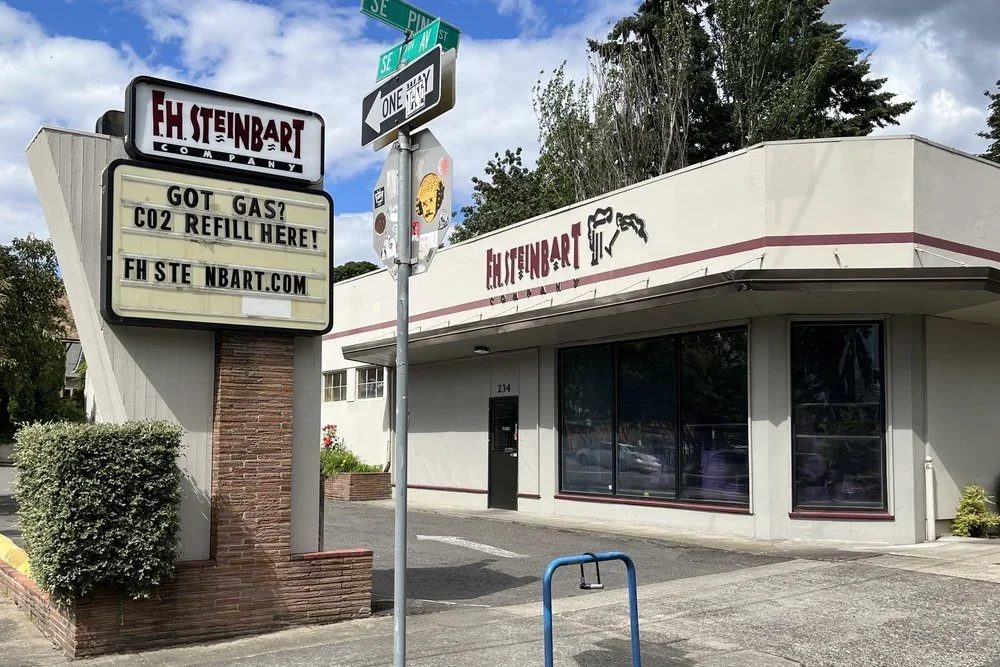
Since Covid and the death of its longtime owner in 2021, America’s oldest homebrew shop—founded before Prohibition—has struggled. A year ago, FH Steinbart found an enthusiastic new owner who tried to breathe life into the business. But alas:
“After 108 years of serving brewers and makers of many types F.H. Steinbart Company, America’s oldest homebrew supply store, will be closing its doors in December 2025. We are profoundly grateful for the generations of customers, employees, and friends who made this place more than a shop. You’ve shared ideas, stories, and beers across a century of brewing history, and that community is what kept us going.”
I have been an unapologetic booster of Oregon’s uniquely rich beer scene, which long predates the craft era. With hop fields, hop breeding, an unbroken lineage of brewing dating almost to the first European-American settlers, yeast labs, and institutions like the Pink Boots society, it is really a special place for beer. And FH Steinbart is very much a jewel in that brewing crown. The first generation of professional brewers, many of them homebrewers, relied on Steinbart for supplies and wisdom. Many future brewers got their start standing in front of the counter listening to advice from one of the seasoned old hands. It’s an irreplaceable piece of our cultural heritage, and it’s heartbreaking to hear this news.


Franz Steinbart was a Prussian immigrant who, sometime around the turn of the century, started selling brewing equipment. That brought him to Oregon, which passed its own version of Prohibition in 1916. Steinbart founded his store two years later, about ten blocks west of its current location. Steinbart ran the store basically over the span of Prohibition, dying in 1934.
Two employees, Joseph DeBenedetti and Angelo Curletto, took the shop over and the former bought it outright in 1957. DeBenedetti’s son, John, started working at Steinbart’s in 1975 and helmed the business until his death in 2021, when his widow MaryKay took the reins. John wasn’t an absentee owner—he was a regular fixture at the shop. Last August, James Ameeti of Perfect Pour acquired the shop with plans to try to keep it going into the future. Speaking to KGW, he described why he couldn’t make it go.
“Fewer people are picking up homebrewing. The hobby takes time, space and effort and that makes it harder for brick-and-mortar shops to survive. Our products are heavy, bulky and low-margin. That combination just doesn’t pair well with rapidly increasing commercial rents in Portland.”
Customers of the store read like a who’s who of Oregon brewing history. One of the most important was the writer and homebrewer Fred Eckhardt, whose 1969 pamphlet A Treatise on Lager Beer introduced a generation to the hobby. A wave of homebrewers in 1970s and ‘80s fed the nascent craft beer movement. The brothers Widmer and McMenamin (and countless subsequent brewers) were regulars.
Writing The Widmer Way, I was surprised to learn that Rob Widmer started brewing while he was briefly living in Montana as a “ski bum.” Where’d he get his supplies? FH Steinbart. The brothers’ uncle, Walter Henzi, was a homebrewer in Portland, and he was a Steinbart regular, so he had supplies shipped from Portland. Steinbart was a local shop, but it had a national impact.
“I remember mail-ordering stuff from Steinbart’s. That’s where he was getting it. I was not familiar with Steinbart’s before; that’s just where people got stuff. I created a number of batches up there. I don’t recall having any written material at that time. I mean, I was broke, so I think just getting the ingredients was a stretch.”
This is just one story from one family, but it illustrates how the concentric circles of beer culture are built. Another fairly well-know local, Alan Sprints, was another regular. Long after he founded Hair of the Dog, he was still teaching an all-grain class at Steinbart, including one that I attended in the late 1990s. I was already a beer fan, but homebrewing took my interest up a notch. When the beer columnist left Willamette Week in 1997, I applied for the job in large part because my homebrewing gave me the (unearned) confidence to think I was qualified for the job. It’s safe to say that had Steinbart’s not existed, I wouldn’t be writing this blog post right now.
Steinbart’s was also the longtime clubhouse for the Oregon Brew Crew, which was both a homebrew club and civic organization. Members were evangelists for everything beery, offering public demonstrations of the brewing process and acting as a volunteer corps for events like the brand new Oregon Brewers Fest. That in turn created more connective tissue that brought people into brewing. In its goodbye statement, the company posted this comment, which isn’t bragging—it’s just history:
“F.H. Steinbart has always been more than a store. It’s been a hub for creativity, curiosity, and connection. A place where anyone could learn, experiment, and share what they loved. For over a century, our mission stayed the same: to give every brewer, winemaker, and fermenter the knowledge and tools to craft something extraordinary.”
Steinbart’s has been a very positive part of my life. It was a lovely, homey little place that always felt welcoming to enter. You’d walk in and be greeted not just by staff, but an unmistakable scent of brewing equipment and, like old libraries, age. Part of the challenge for this store was its very brick and mortar existence—in discussing the closure, Ameeti said he couldn’t compete with cheep supplies Amazon would deliver to people’s homes. But that presence has been so critical to the creation and health of Beervana. Its value far exceeded its wares.
Despite all the brewery closures this year, Oregon is still a wonderful place for beer. The state’s brewers (home- and pro) will be able to manage. But with this closure we lose an important piece of our heritage and a wonderful resource. It just really sucks.
RIP