The End of Reading
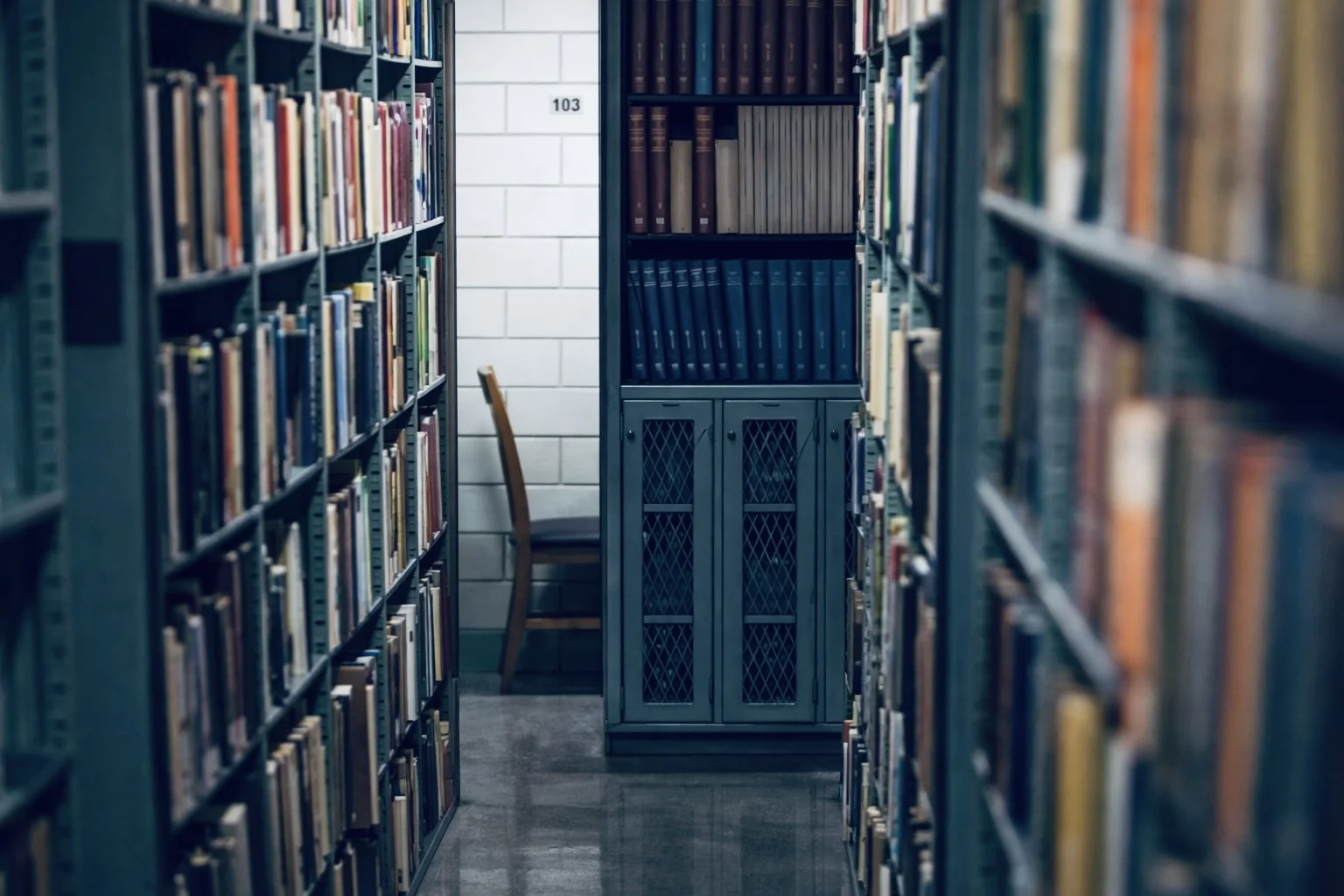
The stacks at Memorial Library. Source: University of Wisconsin
From 1992-‘94, I spent a lot of time inside the endless stacks of the University of Wisconsin’s Memorial Library (78 miles of them according to the official tally, which pedants will note is not literally endless). I worked in the microfilm department and had a study carrel much like the one you see above, which gave me hours to search those stacks. I let curiosity set my agenda. For example, I located every one of JD Salinger’s published short stories and novellas, most of which remain uncollected, and collected them myself. I looked up obscure works by famous writers. I even did a little academic research. I used the hell out of that card catalogue, I think, though now that memory has a fantastical gloss, as if of a dream. Surely we didn’t use little cards? In any case, to underscore the flavor of this era, it was only just before I left the university in an aborted effort to acquire a PhD that I received the address to something called “email.” The internet was a largely notional network of a mere 23,000 pages.
In those years I spent inhabiting the library stacks like a fox in his den, I rarely saw human beings. Partly this was because the library was so vast and filled with so many obscure titles. But it was also the flagship library at a research university with 50,000 students. Which is to say that even before the Internet came to define our lives, people were not giant readers. Most of the novels they read came from the check-out aisle at grocery stores. I mention this ancient history because I’m going to make some bold claims in this post and I want to confirm at the top that this isn’t pure Gen X nostalgia.
Now, zooming through time and space we arrive at early April 2026 and the incident on the couch in Portland, Oregon. I was running an experiment on how well Anthropic’s Claude could help me stand up a Dungeons and Dragons campaign that has been rolling around in my brain for some months. In order to lead such a campaign, a DM needs a ton of written material at their fingertips. Compiling this information takes forever, and except for the flavor text—a derogatory term for descriptions of places the players inevitably ignore—only one person ever sees it.


I don’t really use AI, but after listening to a podcast about how advanced the Claude chatbot has become, I downloaded the app and tinkered with it. I could instantly tell why people were raving. It’s a good writer. ChatGPT offers adequate, error-free writing appropriate for the workplace. (It has a pretty obvious and hacky voice people can spot a mile away, too, which is also appropriate for most workplaces.) Claude’s writing is human and organic and just plain good. Claude’s writing is better than well above 80% of the stuff humans write. Probably above 90%. That is to say in a random sample of a hundred Americans, only ten would write more gracefully than Claude. I learned this by running my experiment.
I started by asking it to flesh out the village of Westfir, where the campaign begins. I gave Claude four paragraphs of facts about the place and gave it detailed instructions about what I wanted. A few minutes later, I had 27 paragraphs describing the town, key inhabitants, specific buildings and businesses, and the town’s political structure. But it was the writing that impressed me. As an example, I hadn’t thought deeply about the name of the village except that it was on the west bank of a river in a forest of fir. (Coming up with names, as brewers will tell you, is laborious and frustrating.) Almost as if it were winking back at me, Claude wrote: “The town's name is straightforwardly descriptive: it sits amid the fir, west of the river. Loggers named it, and loggers are not poets.” I literally laughed out loud.
Claude already produces prose better than many successful genre-fiction writers. It writes far better than most academics. Does it traffic in cliche? Of course. Does it have tics like the overuse of the em dash—that’s the long dash that precedes this clause? Of course it does. And so does 90% of the writing out there. The distance between 90% writing and 100% writing is great, and Claude isn’t about to replace the best writers. It will continue to improve, however, and that line will get blurrier. And anyway, at 90%, it functions well enough to replace anything but the best fiction. It won’t be long before most of the work we read is composed by AI. There are a few exceptions, but in the field of fiction and playwriting/screenwriting, human-drafted work will become a tiny segment of the market, a bespoke artisanal product for those committed to the human voice rather than a rippin’ yarn. (A majority of writers already admit to using AI, and 7% publish AI-generated material.)
That’s only half the equation, though; call it the supply side. The big shift is on the demand side, which is to say the reader.
Future generations may not be able to appreciate the irony here.
Sales stats have only begun to reveal the coming crisis, but reports from the field are alarming. I was recently chatting with Patrick, my econ-professor friend. We were indulging in a little reminiscence about our college days and then he noted that, “It doesn’t matter what incentives I offer, my students absolutely won’t read.” His is far from an obscure view—professors at all levels are reporting the same thing. (Google “college students won't read” and have at it.)
It’s not entirely AI’s fault. Some studies show the problem starts in high school, where kids aren’t taught to read longer or more challenging texts. Recent alarming research has found that AI and the media environment created by our cell phones is literally rewiring young brains so they can’t focus on longer texts. They also don’t have much of an incentive. Why read War and Peace when you can get a quick summary on your phone? When I lurked in the library stacks in the early 1990s, it was the only way to get info. Today most of human knowledge is a Google search away. Why read a book when you can scan a short Wikipedia entry?
Humans are not by nature big readers. Even in the 1990s, they read because they had to. People read potboilers and romance novels for the same reason they watch Netflix—for the plot. (Humans do love stories.) Smart phones and AI are fundamentally changing the reading environment. A subset of people will continue to read for pleasure, but they are the generations who came of age when options were different. They won’t care if the novels they read were written by human or machine, so long as they’re entertaining. I would expect that many of these readers will enjoy the AI-aided novels more. I’m not taking a position on whether this is good or not, just that it is.
The percentage of today’s young people who will develop the habit of reading for pleasure is going to decline precipitously. That means that the function of the written word will shift in society. We’ll still write to each other in texts and on social media (though we may compose this “writing” via spoken word to text, and we may consume it via summary or as text-to-word transcriptions). Some kind of thinking and writing can’t be done by AI. The work I do here, where I go out an interact with the real world and interview real humans and write about the physical experience of drinking beer or the culture of people drinking beer—Claude can’t do that. People will continue to have novel insights about the world and we’ll be keen to hear them. With AI automation, however, we’re just not going to be consuming information through the written word the way we have for centuries. I don’t know how fast this transition will happen. Probably longer than two years. Definitely less than twenty.
For writers, this is a big deal, of course. For a couple years, I’ve been pondering writing a book drawing from my “Classic Beers” series (and new Iconic Beers podcast). I’d like to advance a novel theory about the way we understand beer and use this book as a way of kickstarting that new thinking. Writing a book is a thousand-hour project, however (and Claude couldn’t write this one for me), and I wonder if anyone would read it. The great Martyn Cornell left us a tremendous tome just before he died, and how many people have read it? (I am on about page 30, so I’m casting no stones.) When I started this blog, it would have been mandatory reading, and the blogosphere would have discussed it for weeks. I have the predisposition to write books, and nothing gives me more pleasure, so it sucks to think I may not write another one. But if the best I can hope for is people reading the AI summary, I might as well stick to blog posts.
It’s actually a bigger deal for society, though. For centuries, we’ve had an agreement that we would mediate thought and knowledge through the written word. If an idea was important, we would write it down. Other important ideas would emerge by people thinking about texts and producing new ones. This didn’t just happen at the level of elite knowledge; with universal literacy, we gave the written word primacy throughout society. In the coming transition, we will engage in that writing and reading process far less. It will become a more fully external kind of knowledge, something easily retrievable and disposable rather than something we internalize. Calculators made it possible for us to not learn multiplication. AI will make it possible for us to not learn most things.
This is a long post for a Monday, and it may come across as not especially happy. I’m less freaked out by this development than some of the other challenges threatening us in 2026. We had an oral culture quite recently. As the printing press made mass publication possible, literacy rose. Initially poetry was considered the highest art, but it was replaced by plays, considered a degenerate art form during Shakespeare’s time. The novel arrived in the 19th century, also considered a degenerate form. Television didn’t really replace the novel, but it dented it, and it’s still held in some contempt. Well, now we’re coming to a new epoch, and it will transform society in a new way. Perhaps we’ll return to the oral tradition. Listening to a human voice tell a story may become the antidote to the endless, immediate text our computers generate. I wouldn’t dream of guessing. But something serious is underway and it’s going to come very quickly. I hope we’re ready.