A Blogging Tale (Mostly True)
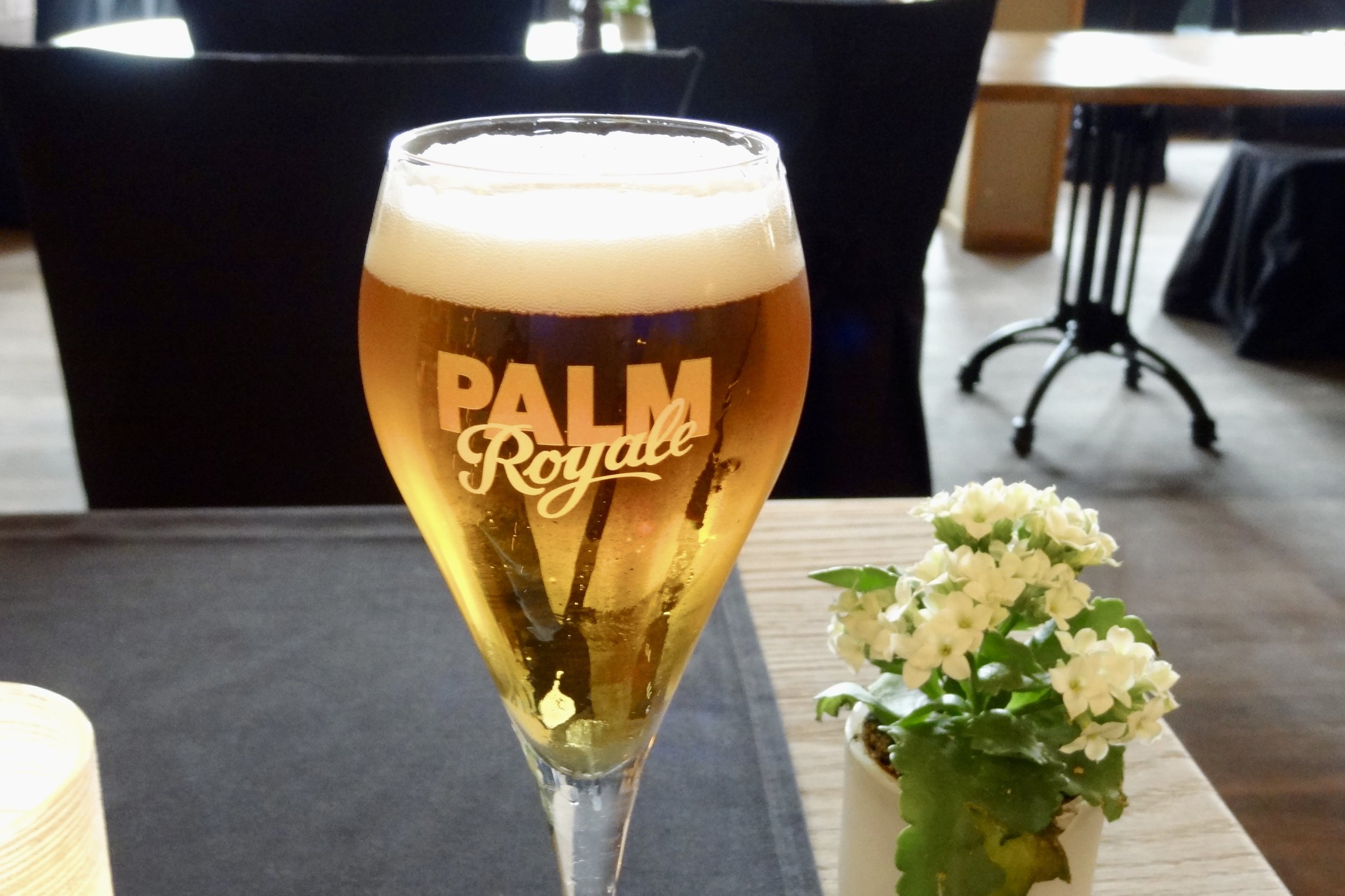
The salience of this photo will become evident in due course.
I was standing next to my idling rental car at an intersection in the countryside north of Brussels. My old-timey TomTom GPS had announced in her plummy English accent that I had arrived at the Palm Brewery, and she was sort of right. In front of me someone—it had to be Palm— had mounted a decorative mash tun. It was a striking objet d’art, but offered no other clues. I knew the brewery had to be close, which was reassuring in its way, but the adrenaline roared through my veins as I looked at my watch. Unusually, I hadn’t arrived early and I was supposed to be standing in Palm’s lobby announcing my arrival in three minutes.
Two years earlier, at age 42, I had come to a decision point. For the previous fourteen years, I’d worked as a researcher for the Graduate School of Social Work at Portland State University. We lived on grants—“soft money”—which meant every two to five years, individual researchers would scramble to find a new project. In January 2010, grant money for my current project would run out and I had to decide if I needed to start a new scramble.


As jobs go, it was excellent. I worked with great freedom at a university, was ensconced in my own office (with a door!), had an adequate but reliable income and awesome benefits, and was doing something truly important. Back in the 1990s, having crashed out of graduate school, I got the job after driving a cab for a year. I was hired as support staff on a new research project that had come out of a landmark lawsuit against the State of Oregon. The state had done such a bad job protecting abused and neglected kids that an Oregon court had ordered them to adopt a new model of care. My project was hired to evaluate it. Within a year and a half, I had managed to convince the PI to promote me to researcher, and in a turn that would have shocked every one of my math teachers, I was actually doing quantitative work. A career path unfolded from there, and had I stayed on it, I would likely be retired right now—probably writing about beer with no concern about my income. I didn’t choose that path.
My midlife crisis began when I turned forty and looked at where my life was. Even before the research job, I had tentatively mapped out a strategy that would lead to a life in writing. Fifteen years later I had published a few stray poems, some opinion pieces, and had scribbled for the beer press. I’d failed to publish my novel. As evidence of success goes, it was not encouraging.
But there were the blogs. I’d founded or co-founded four, one of them a very significant politics site, which meant I wrote furiously through the aughts. It’s a little difficult to imagine now, but for a few years blogs were relevant. The moment of the citizen journalist had arrived, and anyone with an Internet connection could find a real audience. For the struggling writer, blogging offered an encouraging little light in the darkness.
I did find Palm, by madly driving around streets near the gleaming mash tun at random. At the time, Palm owned Boon (re-independent since 2014) and Rodenbach. I wanted to tour those breweries, and in our negotiations, Palm had made it clear they also wanted me to see their family brewery. It was never one of the international darlings like their other holdings, and I sensed their frustration that Americans were so dismissive of their beer. To confirm their suspicions, I expect you have never heard of Palm. They made a pale ale that did well regionally. It was nice, if a little subdued—something like a 5% bière de garde.
In the event, it was an enlightening visit, one that ended up teaching me a lot about Belgian beer. If you only ever visit the darlings, you will learn something—but possibly not about typical practices. In order to get a sense of the normal way of doing things, you need to visit normal breweries. (Schlenkerla is an exceptional brewery and a visit should be in the top five breweries targeted by any beer fan; it tells you very little about German beer, however.)
I arrived in the morning, which is the best time to visit an active brewery: the aroma of mashing grain is a breakfast scent. I do my traveling in the off months, so it was a charcoal November and a cold rain drizzled on my head. The brewery inside was full of bright light and gleaming surfaces and smelled delicious.
I learned about Belgian ale brewing at Palm—the bog-standard, universal practices conducted in some form in nearly every brewery in the country. My guide was a young shift brewer who was happy to show me around—but it was a regular job at a regular brewery and he was just doing his job. He greeted my questions with mild amusement, as if to say, “I can’t believe this interests you.”
Palm. I believe they’ve upgraded the brewery since I visited.
The afternoon before, I had visited Cantillon. I had just flown in from Edinburgh, driven from Charleroi, and gone straight to the brewery. Jean Van Roy was elbow deep in the hop-back as the first of the wort pumped up to the coolship. I spent an hour walking around the brewery—he just waved and told me to enjoy myself—and afterward he pulled out his best bottles of lambic to sample. In those days, before the renovation and “new” taproom, he’d post the dates he planned to brew on Facebook, an invitation for anyone to pop in. Only one other person did. Jean is of course the most philosophical/mystical brewer in the world (lambic-making encourages that predisposition), and the evening was as close to a religious service as I’d experienced.
Palm was something else. It wasn’t an industrial brewery, but it was big—100,000 hectos? It was also beautiful in that Belgian way, with lots of copper and tile. It was a working brewery, loud, with hoses and other hurdles to keep the writer on his toes, and we didn’t linger at any stops. We started in the brewhouse where I encountered my first Belgian cereal cooker—common there, used even by breweries like Palm’s sister, Rodenbach. I learned about Belgian mashing, Belgian sugar (in unromantic liquid form, unlike the “candi sugar” all the books mentioned), and most importantly, Belgian yeast. I visited my first warm room there.
Afterward, I sat in a nearby cafe eating an early lunch. Once the adrenaline from being lost subsided, it was replaced by the intense focus of attention, as I tried to absorb every detail on the tour. At lunch, I finally relaxed and was in danger of pooling up on the floor. Of course I was drinking a Palm beer, which makes a person reflective. In a couple hours I needed to get across Brussels to Lembeek, south of town, for my afternoon tour of Boon. It gave me two hours of contemplation.
When my final study ended at PSU, the country was still clawing its way out of the 2008 recession. Unemployment benefits had been extended to two years. If I was ever going to pursue writing full-time, that was the moment. Worst case, after a year or two of failure, I could go back. Sally and I had long discussions about leaving my good job, and we eventually decided I should take a shot. On February 1, 2010, I went freelance full time.
This blog, which had been a side project for four years, became my main writing outlet. In the pre-social media era, blogs were shorter, faster, and chattier. That first month, I posted 40 times. (Current pace: about 10.) I was working on a book proposal, a slow process, and pitching articles like mad. One of the opaque aspects of freelancing is how much of your time goes to landing work. Pitching stories and books is a form of sales, really, and it’s hard not to feel like you’re out there selling yourself. I have extremely thick skin for this kind of thing, and no individual rejection hit too hard. But each day you wake up having failed to land work leaves you a little less confident.
Blogging was a salve that helped me keep going. It was a DIY project, and subject to the criticisms of blogging at the time (unprofessional, confessional, frivolous, indulgent). I was aware of the criticisms and tried not to lapse into work that would justify them, but it was, shall we say, not the highest calling. I’ve quoted friend and economist Patrick Emerson many times on this point. He used to say, twinkle in his eye, “Blogs? They don’t just give those to anyone!” But I had an audience and commenters, and I could feel the tangible connection to actual human readers. In those days I had a comic tagline that said “Blogs will save us.” Really, I knew that blogs were saving me.
Throughout 2010, I kept blogging and pitching. My book proposal landed me a fantastic agent, Neil Salkind, who in turn put my name in front of Kylie Foxx-McDonald at Workman Publishing. They were looking for a writer to do a brand extension of their massively successful Wine Bible, and asked Neil if I would consider that project. It was a massive shot in the arm to learn they were interested, but the decision process was excruciatingly slow. So after the thrill of possibility, I had to settle into another year of uncertainty.
I kept blogging. My torrid pace continued, but I started taking individual posts more seriously. I did more reporting. Somewhere in 2011, the character of the blog shifted. Social media was displacing the disposable short blog posts of earlier years, and I was doing longer pieces. Another of those opaque aspects of writing: you never know who is reading. I was aware that the blog was my most visible platform, but I saw the traffic numbers; it was hardly the New York Times.
It turned out I had one very important reader: Kylie, the acquisitions editor at Workman. She wasn’t sure I was capable of delivering a quarter-million word manuscript—sensibly, since I’d never done anything like it. I suspect her bosses had even greater doubts. She asked me to submit a proposal for the book, which was awkward, since it was their idea. I realize now they were looking to see how I would organize it, if there was any evidence that I could actually deliver the book. I sent it off and waited.
More than a year after Neil told me they were considering me to write the book, Workman finally made an offer on The Beer Bible. I remember distinctly taking the call with Kylie, standing in the kitchen as we spoke and looking out at the sunny May morning. We spoke about the logistics of what came next, but I wanted to talk about the decision to choose me. By that time it had been months since I’d submitted the proposal, and I’d heard nothing (this was par for the Workman course, I would learn later). Why me? I asked Kylie.
“I read your blog,” she told me. “I really love your voice. It’s a lot like Karen’s [Karen MacNeil, Wine Bible author] light and fun, but authoritative. I know you’re not very experienced, but I just thought your voice was right for the book.”
I chose to frame this blog post around my trip to Palm because I remember thinking about all this history as I was eating lunch after the tour. I was a little less than a quarter of the way through a grand adventure that would take me to the world’s great European breweries. It was such incredible, heady stuff. On that Belgian leg alone, I toured the breweries with the master brewers (!) at Cantillon, Boon, Rodenbach, Dupont, Dubuisson, St Feuillien, Orval, and Rochefort. I visited but didn’t tour several others, including Westvleteren.
At Palm, gearing up to meet with Frank Boon on what would be an eight-hour interaction that continued on to dinner, I had a sense of vertigo. Like Wile E. Coyote, I feared looking down. Less than six months earlier, I was confronting the end of my short, uneventful time as a freelance writer. I was 43 years old and if writing wasn’t going to pan out, what was the alternative? Instead, there I was sipping a beer at 11 o’clock in the morning in Steenhuffel, Belgium, halfway around the world from Portland. From famine to feast—and all because of a blog.
This blog, which turns twenty today.
I still have a sense of vertigo when I think about that period in my life. Thanks to this blog, I got to write four more books (with more to come, I hope). I’ve traveled to a dozen or more European countries on beer-related adventures. I’ve met some of the world’s great brewers (some who don’t realize it themselves). The blog got me the Beer Bible, and the Beer Bible gave me a career. Eventually, I started soliciting sponsors for this blog, and lo, some of the most prestigious breweries from the region and the world stepped forward to support my work. (Thank you so much for believing in me Guinness, pFriem, Breakside, and Reuben’s!)
Finally, I want to thank you, the readers of this blog, who played the most important role of all. You commented and argued and corrected—and you read. For twenty years, through ups and downs, you’ve read what I wrote. It’s the wonderful thing about blogs. More than any other medium I know, that connection between the blogger and the reader is most present, active and dynamic. I don’t know what I would have done without you, and I’m glad you’ve never made me try. On to the next twenty years—