An Interview With Andreas Krennmair
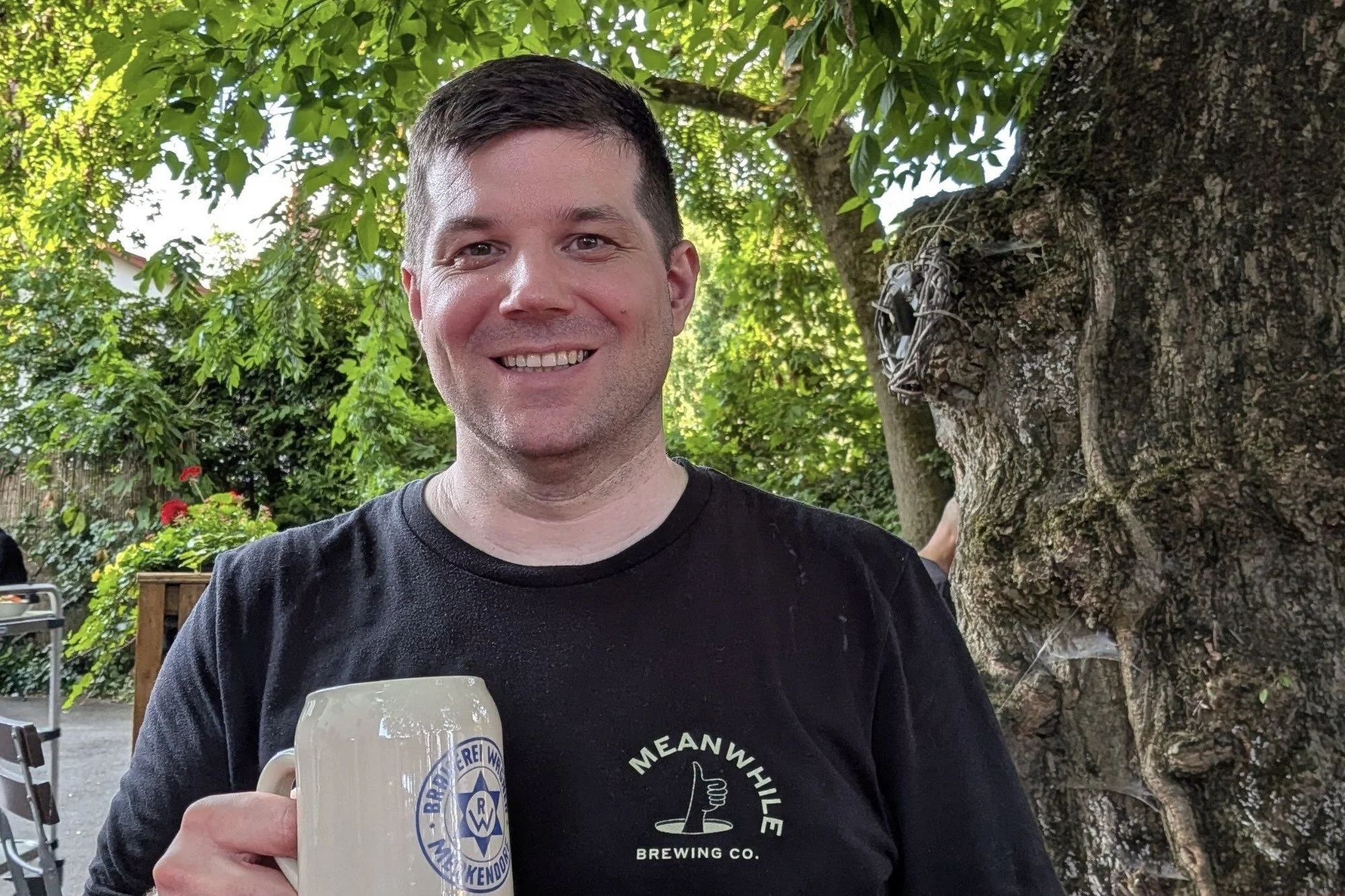
After I completed Andreas Krennmair’s excellent Bavarian White Beer, I had many questions about the author behind the book. Andreas is doing wonderful, essential historical research, and I wanted to know more about his background, life, and process. Below is an interview we conducted via email. Note: I lightly edited my own prompts for clarity and broke some of Krennmair’s text blocks into smaller paragraphs.
Jeff Alworth: Can you give us a little background about who you are and your background?
Andreas Krennmair: I'm originally from Linz, Austria, where I grew up, but I've lived in Berlin, Germany for the last 17 years. My main profession for the last 20+ years has been software development, and better job opportunities at a higher pay combined with lower costs of living was one of the reasons why I moved to Germany. I still work as a software developer, currently 100% remote for a small startup based in Munich. Beer has been a passion for me for a long time, but never a full time job.
You're doing serious academic history work. Did you study history? How did you get into it, and if you didn't study history, how'd you learn this discipline?
I have no formal qualification as a historian. In fact, in secondary school, I really wasn't keen on the subject of history, and never had particularly good grades, but only much later I realised that it had to do with the teachers and their methods rather than history itself.
I did have an interest in specific elements of history, though, especially the one I was surrounded by: the place where I grew up used to be a base for the peasants during the Upper Austrian peasants war of 1626. It was also the site of the Battle of Ebelsberg on 3 May 1809 between French and Austrian troops during the Napoleonic Wars. And Linz itself has a long and rich history that is hard to avoid. I distinctly remember that in 1998, my school's school yard renovations were delayed because ancient Roman artefacts had been found. Because of this very historic environment, I got interested in history in general, just not in a way that would have helped me in secondary school.

I never even thought about professionalising that in any way, and I really only acquainted myself with a few basic techniques of historic research when I started working on my first book about beer history and homebrewing. That's why I introduce myself as an amateur beer historian, but so far, my work seems to have held up to the scrutiny of historians with academic backgrounds.
What drew you to study beer history?
The first book that I wrote started out as a collection of historic beer recipes that I had gathered, and in some cases reconstructed, from old sources. For each style, I also wanted to research more of the history, and I wanted to that well, because already quite early on I had noticed that a lot of "stories" around beer styles were essentially without any proper sources and often sounded too good to be true. So I sat as my own quality standard to have sources for everything and to approach all of these sources in a critical manner.
After the first book, friends of mine encouraged me to write a book that focused on the history of Vienna Lager, and that's when I decided to dig even deeper and put together a well-researched and well-sourced history of this historic beer style, ideally as complete as possible, where I again held myself accountable to the standard of critically examining sources and most importantly documenting every single source that I used. Already after the first book, I knew that I really enjoyed this kind of research, and it turned into a hobby of mine. I also earn a bit of money through book royalties, but it's still a hobby first and foremost.
Relatedly, how did you get into homebrewing and how does this inform your research?
When I first met my now wife in December 2011, we had a shared interest in beer. This was well before craft beer was much of a thing in Germany at the time. She's originally from Northern Ireland and lived in the south of England for a long time, so when we first visited the UK, she introduced me to cask ale, which opened up a whole new world for me. Shortly after that, we decided to try out making cider at home, with windfall apples we picked up ourselves outside of Berlin. That was successful, so my wife suggested we could also try homebrewing beer.
I looked into it a bit what the German homebrewing community at the time was suggesting, and it was simple enough. I remember the first beer I brewed, it was meant to be an English pale ale, but the recipe wasn't great: 90% Vienna malt, 10% CaraHell, hopped with East Kent Goldings and fermented with Wyeast London Ale III. I was impatient, bottled the beer slightly too early and it ended up over-carbonated. But it was still drinkable and pretty good for a first try I thought, so I continued brewing beer, and very quickly ventured into writing my own recipes.
My interest in history then got me into looking into historic brewing books. On Google Books, I found quite a few British ones from the 18th century, and it was fascinating to see how much of the brewing process described in these old books was remarkably close to how I brewed beer at home. So I kept on searching and reading, and started collecting historic recipes and converting them into modern units. That's what really sparked my interest in beer history, me trying to understand these beers better, trying to understand the brewing ingredients and processes, but also learning more about the general history of these old beers.
The main reason to start homebrewing though was to brew all the beer styles I couldn't get in Germany. Craft beer only really started to become a thing here around 2012/2013, and some of it wasn't even very good. I never brewed many Hefeweizens, because the quality of Hefeweizen is just impeccable. Instead, I brewed British styles and to some extent American styles. Nowadays, as my interest in beer has shifted a bit, my homebrewing has also shifted towards the styles that I enjoy the most but can't get. That includes Vienna Lager as well as Czech beer styles: over the last few years, I've perfected a pretty good tmavý recipe together with a good friend, I've brewed a few Czech-style 8° beers, and most recently a 10° polotmavý. Occasionally, I also like to brew a best bitter. My understanding of the style has improved a lot since my first batch of homebrewed beer, and ingredient availability in Germany has also improved a lot, so I can now brew English styles with proper British pale malt and British crystal malt that then tastes almost like what I'd be served from cask in a traditional British pub.
Tell us a little about how you go about your research. Where do you find your sources?
I found a lot of my sources online. Google Books was my first stop, then archive.org, and of course HathiTrust Digital Library. Then there are newspaper archives that are very helpful, such as Chronicling America by the Library of Congress, then the ANNO historic newspaper and magazine archive by the Austrian National Library, or the newspaper portal of the German Digital Library. The Bavarian State Library also has a vast array of books and publications available in digital form, and the Free State of Bavaria runs a comprehensive online portal with digitized content, including historic books, historic photographs and pictures. In addition to these online sources, I also do research in libraries, mainly in the excellent library of the Society for the History of Brewing which is housed in the building of VLB Berlin. The library has a vast collection of books relating to all kinds of beer-related topics, including historic books. Without it, I never would have gotten as far in my research. In that sense, I was really lucky and I'm really privileged to have such a top beer history library nearby: by public transport, it only takes me about 15 minutes to get there, and it's accessible to the general public.
As for what topics I'm researching, sometimes it's just random stuff I stumble upon and then decide to take a closer look. That's how many of my beer history blog posts are conceived. Many evenings, I just spend randomly browsing through historic brewing magazine or literature, just to see what I come across. It's relaxing for me, and sometimes, I just come across something that I find dead interesting and decide to research it further. Sometimes, I also go back to subjects that I hadn't looked into for years, just to see whether I can find out more about it.
You have written two deeply-researched books about Vienna lager and weissbier. Researching and writing a book takes a lot of time and effort and you bcome quite intimate with the subject. What drew you to do such detailed work with these styles?
The motivation for my Vienna Lager book was that friends of mine encouraging me to write it, after my first book contained a small section on it. Initially, I wasn't even sure whether I would have nearly enough material to write a proper book about it, but once I started investigating sources, I started to understand that there was a lot more to it than I had initially realised. What also helped me in my decision to write the book was that there simply wasn't a comprehensive book about the topic in the first place. At the time, there was only "Vienna, Märzen, Oktoberfest" by George and Laurie Fix, and I didn't think it did the beer style justice, both in the history it presented, and in the homebrew recipes it contained. The book was clearly a child of its time, and it shows in e.g. how the authors talk about very fundamental ingredients like quality Vienna malt being unavailable to US homebrewers, which is why they replaced it with pale 2 row malt and caramel malt. The whole topic of Vienna Lager could be covered much better and more comprehensively, including a deep dive into how I reconstructed how Vienna Lager was brewed during the 19th century, both from a raw material and a brewing process perspective.
For my book about Bavarian White Beer, the motivation was similar: while there were some books around that covered the brewing side, such as "Brewing with Wheat" and "German Wheat Beer", their focus was clearly different and less focused on beer history. I only realised that there was a big gap was when Jonny Garrett, a fellow beer author and content creator from the UK, got in touch with me about some specific details about the early history of Bavarian wheat beer. That's when I saw that there was no book about the subject as a whole that covered the general history, historic brewing and modern brewing. I also came across a number of highly specialised, very academic German books covering specific elements especially of the early history of the beer style, and none of these seem to have been received in English-language beer literature whatsoever. So I saw the gap, saw that there was already quite a bit of research, and then started collecting sources, both primary and secondary, that covered the whole time period from late Middle Ages until effectively today.
Due to my previous experience in researching and writing, it was a much more focused effort, and I wrote about 70% of the book within just 3 months, often in the evening and during weekends, followed by about half a year of identifying gaps in the narrative, trying to find sources to cover them, and turning all of it into a neat book. I also asked professional brewers for homebrew recipes, developed and trialled a few recipes myself, and even documented how you make your own air-dried wheat malt, which I think added a lot of value for homebrewers.
As part of the research, I reacquainted myself with the Bavarian wheat beer. This used to be a beer style I quite enjoyed when I was younger, and drinking it nowadays made me appreciate how much complexity there is to it, and how much innovation still happens, both in academic brewing research and in practical brewing. One of my absolute favourites these days is Schneider Festweisse, a slightly modernised recreation of a 1920s recipe that is slightly hoppier, and that hoppy edge incredibly boosts drinkability.
Looking forard, what other styles interest you and what book might you tackle next?
The next project I already started working on is a second edition of my first book, Historic German and Austrian Beers for the Home Brewer, with more historic beer styles, more homebrew recipes, and more general history about each of these styles. In terms of specific styles that I want to research, I've not really found anything yet. I think a critical history about Oktoberfest would be good to have, especially since I noticed in recent years how recent a lot of Oktoberfest traditions really are, and how these traditions seem to be used to corner a lucrative market. A good friend of mine a few years ago also said that there's next to nothing around about genuine Dortmunder Export, but I know so little about that style, I don't feel comfortable yet to accurately represent it in any shape or form. And then there's the big topic of Berliner Weisse, another style with a lot of history, but I specifically avoided it because another good friend of mine has been working on a comprehensive book about its history for several years, which will hopefully be published in 2027.