Is AI Going to Screw Up Pubs? (Real Question)
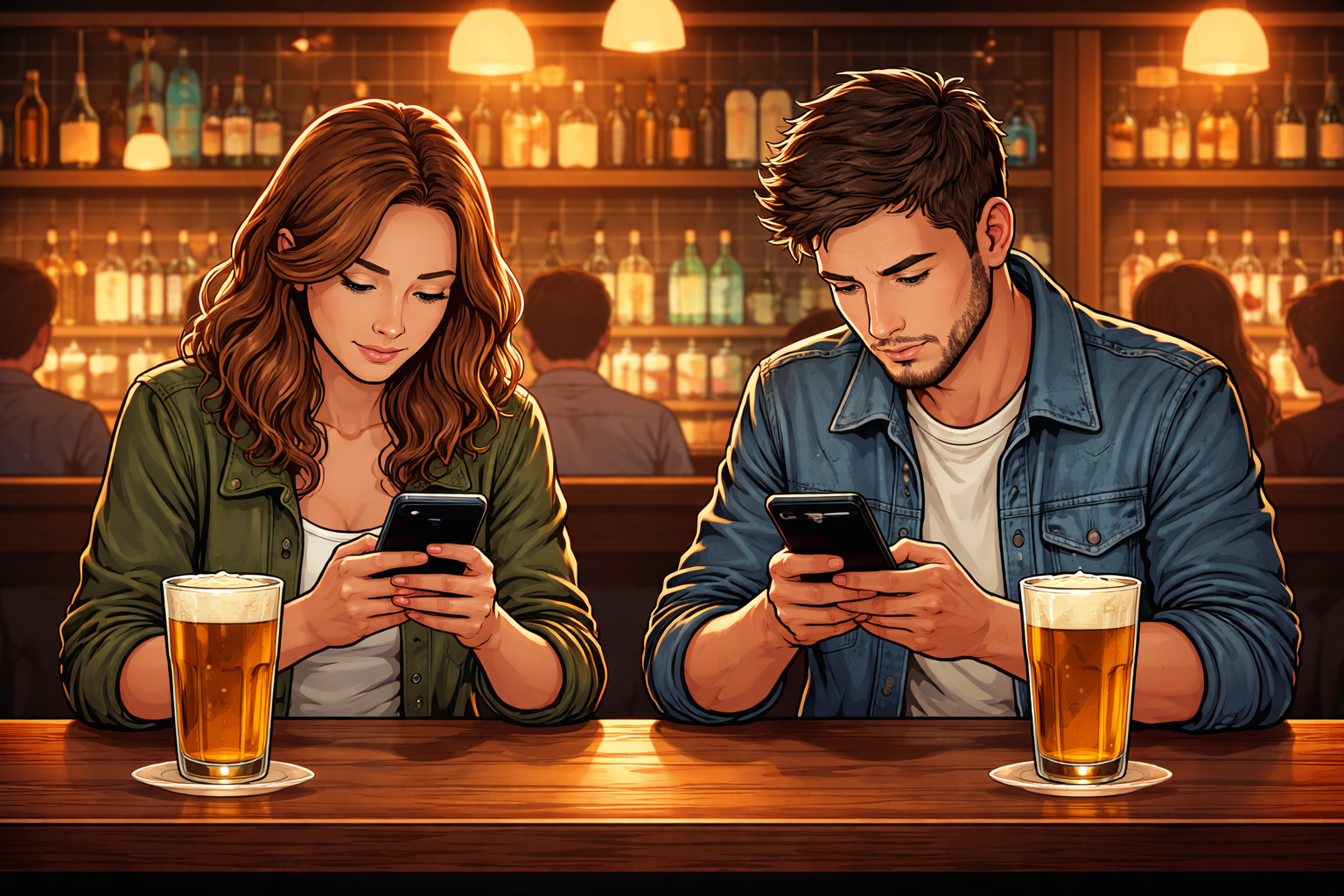
I resolved not to use AI art last year, but this seemed like an irresistible opportunity. Enjoy the slop!
Clay Shirky, Vice Provost at NYU, published a very troubling piece recently in the New York Times about the way AI is socially crippling people under 25. He offered a number of examples, including one in which college students caught cheating with AI then used it to draft their apologies. Even then, he writes, “they still wouldn’t (or couldn’t) forgo A.I. as a social prosthetic.”
Social prosthetic, there’s a phrase.
It seems apt for a cohort increasingly paralyzed by social interactions. Shirky quotes an astounding finding that 46% of ChatGPT’s queries were made by young adults 18-25. Maybe that’s off a bit, but even so, holy god. He continues, “Teenagers and young adults, stuck in the gradual transition from managed childhoods to adult freedoms, are both eager to make human connection and exquisitely alert to the possibility of embarrassment.”
Given how alcohol, entertainment venues for drinking same, and adulthood have historically been woven into a single fabric, I immediately began to wonder what would happen if AI was added to the mix.


Learning to manage the stress of embarrassment is one of the key milestones of childhood. That burn of embarrassment is a rite of humanity—and surviving it is what prepares us for adulthood. It’s the first trauma we experience, and sometimes it leaves lifelong scars. Tweens and teens from every generation try to avoid it, but most learn the only way out is through. AI is creating bypasses for young people, though, who are using it to navigate around scary situations.
That 18-25 year-old group has even more incentive, or more fear, anyway, than past generations because they are uniquely unprepared. They missed important social opportunities starting when they were 12-19 thanks to a multi-year global pandemic. Having already been trained to live life through a screen, ai would imagine that predisposed them to have ChatGPT at the ready.
Of course, alcohol and pubs have long been one of the key ways young adults have mediated this period of life. Getting out and spending time with friends under the expansive effects of alcohol has been a time-honored tradition for thousands of years (probably—some speculation there). When young people go out in packs to experience the world, they develop the social skills they’ll take into the workplace, dating, and casual social encounters. Alcohol isn’t called “liquid courage” for nuthin—it is the old-school tool people relied on for those scary social environments. Pubs and other late-night drinking venues are an important staging area, too, sort of like an adult playground with defined spaces and rules. They come in myriad different forms to appeal to the different personalities of their patrons. But what happens if they just seem too scary with their wild, unregulated social spaces?
We think of pubs and cocktail bars and music venues as permanent, mostly unchanging fixtures of life—but we thought that of schools and colleges, too. And AI screwed those up. “Most every place where humans are offered mediated communication,” Shirky writes, “some company is going to offer an A.I. as a counselor, sidekick or wingman, there to gas you up, monitor the conversation or push certain responses while warning you away from others.” I’m not sure what that looks like in pubs—and I don’t want to find out.
I started writing about AI just four years ago on this blog, back when it was mostly theoretical. It hadn’t yet affected society in any real way. Now it is unavoidable. In its ubiquity, we’ve adjusted to it. For most of us, it’s not even alarming anymore. AI has become just more digital background noise. Four years ago, a story like Shirky’s would have seemed outlandish. The idea that AI might change pubs and the way we drink beer in the future seems outlandish today, but things change. I’ve learned to be humble predicting the future.
There’s another possibility, though. AI may screw up pubs and beer, but pubs and beer may, conversely, interrupt this process of AI-fueled social incapacity. If we can get these poor young people into a pub and put a beer and another person in front of them, nature may take its course. That prescription has a pretty good track record!
________________
As a post script, it’s important to acknowledge that using alcohol as a social lubricant is dangerous. The danger grows proportionally to the youth of the drinker. I believe that pubs can be important places for the kind of social interaction that is vital to human flourishing. Alcohol can also play a positive role there. I won’t minimize the risks, though.